 Our single B-cell derived recombinant rabbit monoclonal antibodies have vastly improved reliability and reproducibility.



 Cart (0)


When a mother’s immune system is activated during pregnancy—whether by infection, inflammation, or other stressors—it can influence how the developing brain forms. This phenomenon, known as maternal immune activation (MIA), has been linked to a higher risk of neurodevelopmental disorders such as schizophrenia and autism in children. But not all offspring are affected equally. Some remain resilient, while others develop lasting cognitive difficulties. Understanding why has become a major question in neuroscience and psychiatric research.
A research team from the University of Lausanne, Switzerland, set out to understand what makes some individuals more vulnerable to MIA than others. They focused on the body’s redox balance—the delicate equilibrium between reactive oxygen species (ROS) that can damage cells, and antioxidant systems that protect against this stress. Since oxidative stress is a well-known cause of DNA and cellular damage, the team hypothesized that differences in antioxidant defenses might explain why only certain offspring develop cognitive impairments after MIA.
Inside the Study
The researchers used a rat model of maternal immune activation. Pregnant rats were given poly(I:C), a compound that mimics viral infection, to trigger an immune response. Once the offspring reached young adulthood, their cognition was tested using the novel object recognition (NOR) task, a standard test for memory and recognition ability. Based on their performance, the animals were grouped into resilient (normal cognition) or vulnerable (impaired cognition) categories.
To probe antioxidant defenses, the team measured superoxide dismutase (SOD) activity, an enzyme that neutralizes ROS and protects cells from oxidative stress. For this, they used the EpigenTek EpiQuik™ Superoxide Dismutase (SOD) Activity/Inhibition Assay Kit, which allows sensitive, reproducible detection of SOD activity directly from plasma samples. This kit provided a critical readout of antioxidant status in the animals, enabling the researchers to link redox capacity to cognitive outcomes.
Results using the EpigenTek Kit
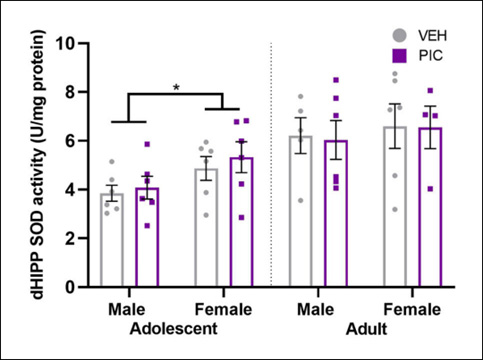
The analysis revealed that plasma SOD activity was significantly reduced in the vulnerable group compared to both controls and resilient animals. This finding suggests that inadequate antioxidant defenses—and the resulting excess oxidative stress—may contribute to long-term vulnerability after maternal immune activation. Reduced SOD activity indicates a higher risk of DNA, protein, and lipid damage, providing a mechanistic link between immune stress during pregnancy and later cognitive impairments.
Overall Study Findings
Taken together, the study shows that not all offspring exposed to maternal immune activation are affected in the same way. Vulnerable individuals had lower antioxidant capacity, as shown by decreased SOD activity, and were more likely to experience cognitive deficits. Resilient animals, by contrast, maintained stronger redox balance and normal cognition. These results highlight SOD activity as a potential biomarker of susceptibility to neurodevelopmental disorders.
This research underscores the importance of redox balance and oxidative stress in shaping long-term brain health. By using the EpiQuik™ SOD Activity/Inhibition Assay Kit, the investigators identified a measurable biological marker that distinguishes vulnerable from resilient individuals after maternal immune activation.
As research advances, antioxidant defenses may become a therapeutic target, and SOD activity could help predict individual risk. For researchers looking to further explore oxidative stress and its consequences, EpigenTek offers a range of DNA/RNA Damage & Repair Assay Kits. These highly sensitive, ELISA-like kits provide accurate detection of oxidative DNA and RNA lesions, such as 8-OHdG for DNA and 8-OHG for RNA, enabling scientists to directly measure the cellular damage caused by redox imbalance.
Whether studying the origins of psychiatric disorders, cancer biology, or general mechanisms of oxidative stress, EpigenTek provides the tools to uncover how redox dysregulation translates into DNA and RNA damage—and how restoring balance may offer new therapeutic opportunities.



