 Our single B-cell derived recombinant rabbit monoclonal antibodies have vastly improved reliability and reproducibility.



 Cart (0)


It’s not just DNA anymore. RNA is also subject to epigenetic modifications, and lately studies have focused on deciphering the “epitranscriptome”, modifications to RNA that can affect RNA metabolism and gene expression, conferring yet another level of epigenetic regulation. RNA modifications are numerous, more so than in DNA. Up to date, there are more than 100 RNA modifications, including RNA methylation, reported in different species. Two major modifications in RNA consist of base methylations, methylation at position 5 in cytosine, 5-methylcytosine (5-mC) and methylation at position 6 in adenosine, 6-methyladenosine (m6A). m6A is the most abundant mRNA modification, and is also present in tRNA, rRNA, snRNAs, and long non-coding RNAs. Although m6A was known to be present in RNA since a few decades ago, it wasn’t until recently, with the discovery of its first eraser enzyme, that this modification gained acceptance as a dynamic mark with potential regulatory roles.
Investigate RNA methylation by measuring m6A using EpiGentek’s EpiQuik m6A RNA Methylation Quantification Kit or measure 5-mC in RNA with the MethylFlash 5-mC RNA Methylation ELISA Easy Kit (Fluorometric) and with our m6A Antibody.
 m6A writers, erasers and readers
Methylation of adenosine is catalyzed by an RNA methylase multiprotein complex, which comprises methyltransferase-like 3 (METTL3) and methyltransferase-like 14 (METTL14) as protein components. Others proteins, such as Wilms tumor 1-associated protein (WTAP) and protein virilizer homolog (KIAA1429), also associate with this multiprotein methylase complex, and are required for m6A methylation. WTAP does not have methylase activity, but instead it is thought to be responsible for translocation of the complex.
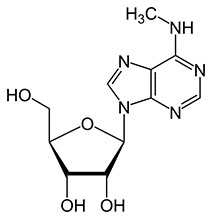 N6-methyladenosine.
As of the m6A readers, m6A binds YTH-domain proteins. This family of proteins comprises 5 members, including YTHDF1-YTHDF3, and YTHDC1 and YTHDC2, and differ in cellular distribution and in their role in the regulation of mRNA.
Transcriptome-wide studies
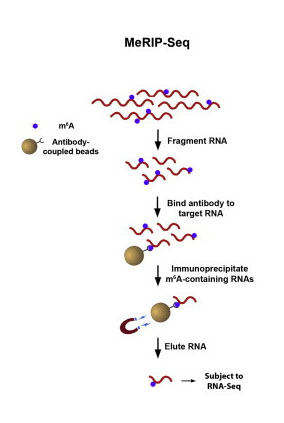
Schematic representation of MeRIP-Seq in Dominissini D, et al. (2012).
The above studies by meRIP-Seq produced m6A peaks, and a resolution of ~100 bp, but did not identify individual m6A residues. More recently, the first single-base pair resolution maps of m6A in mouse and human have been generated also using immunoprecipitation with m6A antibodies, but this time combined with UV light crosslinking (3). In this study by Linder and colleagues, the m6A antibodies were crosslinked by UV light to m6A residues in RNA. During subsequent reverse transcription of the mRNA this produces unique mutations at m6A sites, and by NGS of the cDNA library, these distinct mutational signatures can be used to identify the m6A sites and their location along the mRNAs.
They designated this technique as miCLIP (m6A individual-nucleotide resolution crosslinking and immunoprecipitation). Using this technique, the authors were able to identify ~9,500 m6A sites in the transcriptome of human embryonic kidney cells. They confirmed that m6A sites located mostly to the coding sequence and 3’UTRs, with enrichment at stop codons. They also identified m6A residues in small nucleolar RNAs (snoRNAs), and that these residues were located at single stranded regions of the snoRNAs. Since then, other groups have generated additional high-resolution maps of m6A. Altogether, these studies have made possible the identification and location of enrichment sites for m6A in mRNA and other RNA classes, and this will enable more refined molecular studies to better understand the functional roles of adenosine methylation.
Roles Enrichment of m6A at 3’UTRs, suggests that m6A may be important for mRNA regulation, as this region is important for mRNA stability, localization and translation, and may affect binding of RNA-regulatory proteins to these regions.
Biophysical studies suggest that m6A can affect RNA structure. One m6A residue can destabilize the RNA duplex, and sites adjacent to m6A sites tend to be more single-stranded. This structural remodeling by m6A has been called “m6A switch” and may cause RNA-binding sites to be exposed and increase binding by RNA-binding proteins. One such protein is the heterogeneous nuclear ribonucleoprotein HNRNPC, which controls processing of mRNA transcripts. This is a possible mechanism by which m6A may influence mRNA processing.
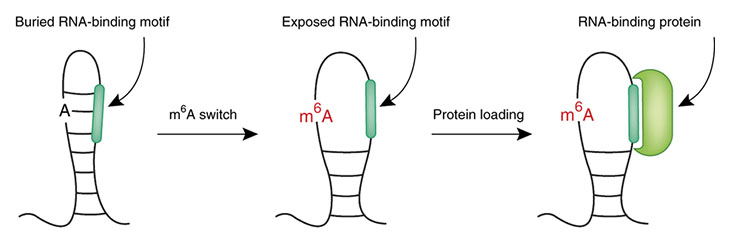 M6A Switch: m6A alters local RNA structure, thereby exposing RNA binding motifs and facilitating protein binding. Credit: Liu, N. and Pan, T. (2015).
References:
- Dominissini D, et al., Topology of the human and mouse m6A RNA methylomes revealed by m6A-seq. Nature. 2012 Apr 29;485(7397):201-6.
- Meyer KD, et al., Comprehensive analysis of mRNA methylation reveals enrichment in 3' UTRs and near stop codons. Cell. 2012 Jun 22;149(7):1635-46.
- Linder B, et al., Single-nucleotide-resolution mapping of m6A and m6Am throughout the transcriptome. Nat Methods. 2015 Aug;12(8):767-72.



