 Our single B-cell derived recombinant rabbit monoclonal antibodies have vastly improved reliability and reproducibility.



 Cart (0)


A study published in Biological Research identifies the fibrinogen alpha chain (FGA) gene as a novel target of histone acetylation that regulates granulosa-cell survival in ovarian follicles. The researchers discovered that both chromatin accessibility and histone acetylation at the FGA promoter are essential for controlling its expression, directly influencing whether granulosa cells proliferate or undergo apoptosis.
Reduced promoter accessibility and diminished H3K9 acetylation were observed when HDAC2, a histone deacetylase, was knocked down. This suppression of FGA expression led to impaired granulosa-cell proliferation and increased apoptosis, resulting in disrupted follicle development. In contrast, higher FGA expression promoted cell-cycle progression and protected against apoptosis, supporting normal ovarian function. These findings establish FGA as a new epigenetically regulated gene critical for reproductive biology.
Measuring Chromatin Accessibility with EpigenTek Technology
To assess promoter accessibility, the team used the EpiQuik™ Chromatin Accessibility Assay Kit from EpigenTek. By examining five subregions (P1–P5) of the FGA promoter, they generated a fine-resolution map of chromatin openness under HDAC2 knockdown conditions. The results showed a marked reduction in accessibility (Fig. l), which correlated with diminished H3K9ac enrichment (Fig. m). This combination of accessibility mapping and histone acetylation analysis provided a clear mechanistic link between chromatin structure and FGA regulation.
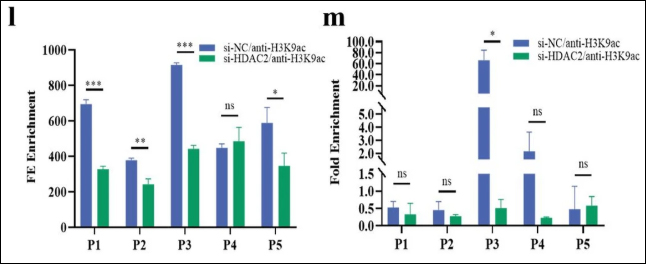
Chromatin accessibility at FGA promoter subregions (P1–P5) was measured with the EpiQuik™ Chromatin Accessibility Assay Kit. HDAC2 knockdown reduced accessibility (Fig. l) alongside diminished H3K9ac enrichment (Fig. m), demonstrating the kit’s power to resolve promoter-level epigenetic regulation. Chen et al., 2025, Biological Research
Chromatin Structure Shapes Cell Fate
The study concludes that FGA expression is governed jointly by histone acetylation and promoter accessibility, which together act as the mechanistic bridge between epigenetic modification and gene-driven outcomes in ovarian follicles. This discovery highlights chromatin accessibility as a functional regulator of gene activity, not just a marker, and underscores its role in determining cell survival.
Implications Beyond Follicle Development
While the study focuses on ovarian biology, the implications extend broadly. Chromatin accessibility and histone acetylation are universal mechanisms of gene regulation. The approach used here demonstrates how locus-specific chromatin accessibility assays can uncover gene-level mechanisms that genome-wide methods may miss. These findings provide a framework for future studies in cancer, developmental biology, and other diseases where epigenetic control of gene activity is critical.
How EpigenTek Supports Chromatin Research
EpigenTek is proud to support discoveries like these with innovative, streamlined technologies. Our chromatin accessibility kits and full suite of chromatin research solutions help researchers profile gene-specific accessibility, integrate epigenetic data, and accelerate breakthroughs in gene regulation. Whether studying fertility, disease, or development, EpigenTek provides the tools to advance chromatin research and translate complex epigenetic mechanisms into meaningful insights.



