As the COVID-19 pandemic continues to evolve, researchers are scrambling to figure out how to keep us safe. Over the past year, vaccination efforts have increased hoping to curb transmission and limit sickness and hospitalizations. Even still, COVID-19 cases significantly increased when the Delta variant found its way to the US in mid-July 2021.
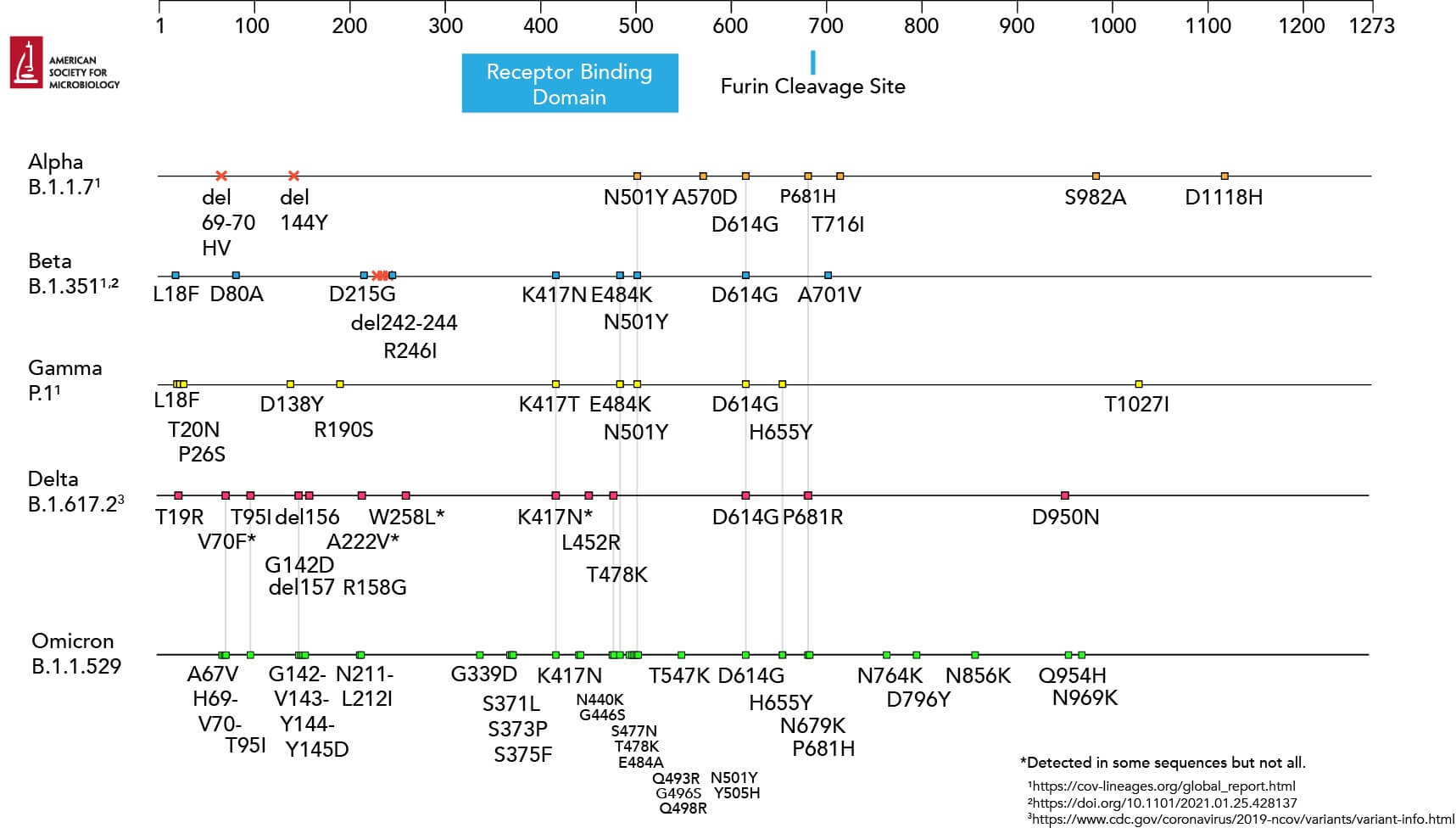
Amino acid changes to the spike (S) protein in SARS-CoV-2 variants of concern (VOCs). (Click to expand image.)
Source: American Society for Microbiology
Coronaviruses are a family of RNA viruses found in both humans and animals. To cause infection, it connects to the host’s cell receptors using its spike-like proteins, and enters the host cells via an angiotensin-converting enzyme. With the emergence of new and highly infectious variants of COVID-19, research suggests cytosine deamination as a major contributing factor to the evolution of the SARS-CoV-2 coronavirus.
The newest identified variant is called Omicron (B.1.1.529), and was found initially in South Africa. The WHO designated omicron as a variant of concern on Nov 26th, 2021 and it has quickly become the most common variant of the novel coronavirus in the US.
The spike protein of the Omicron variant is characterized by at least 30 amino acid substitutions with at least 15 of the 30 amino acids being found in the receptor binding domain (RBD), one small insertion and three small deletions. Early research has indicated that Omnicron may play a role in DNA demethylation, specifically by affecting APOBEC3 cytosine deaminases.
Epigenetic research is more important than ever, especially when the scientific community is trying to stay ahead of ever-evolving viruses. Having access to the right tools is imperative to making scientific advancements, especially in the middle of a pandemic.
The APOBEC (apolipoprotein B mRNA editing catalytic polypeptide-like) protein superfamily serve as cytidine deaminases and catalyze deamination of cytidines to uridines in both DNA and RNA. The extensive C-to-U substitutions displayed by the SARS-CoV-2 genome indeed may imply an APOBEC3-driven mechanism. Detection of APOBEC3/A enzyme activity and inhibition would thus be of great benefit in virus infection control, and the development of novel target-based anti-viral therapeutics
Activity/Inhibition of total APOBEC3 enzymes or APOBEC3A enzyme can be conveniently assessed with these rapid colorimetric assays in only 4-5 hours, using cell extracts or purified enzymes as input material. An assay standard is provided in each kit for the quantification of enzyme activity. The innovative kit compositions enable background signals to be extremely low, allowing the assays to be simple, accurate, reliable, and consistent.
For measuring the activity/inhibition of APOBC3A enzyme using cell extracts or purified APOBEC3A from human and other mammals
Furin Cleavage Site (FCS)
SARS-CoV-2 harbors a unique furin cleavage site (FCS) at the boundary between the S1 and S2 subunits of its spike protein, which can be cleaved by the proprotein convertase (PC) furin and furin-like PCs. Proteolytic activation of SARS-CoV-2 spike protein at the S1/S2 boundary facilitates interaction with host ACE2 receptor for cell entry. The SARS-CoV-2 FCS contains a core region SPRRAR│SV (8 amino acids, S680-V687) that could be cleaved by furin and/or furin-like PCs secreted from host cells and bacteria in the airway epithelium. Furin and furin-like PCs such as PC5/6A and PACE4 are proven to be cleavage region sequence-specific, and these PCs exhibit widespread tissue distribution. The P681 site mutating to R681 has been observed in the Delta variant and shown to cause higher infection and transmission than the wild type.
For screening blockers of the SARS-CoV-2 FCS containing the P681R mutation and/or inhibitors of furin and other serine proteases that may also target the P681R mutant FCS of SARS-CoV-2
For antibody-based applications requiring high specificity to the S1/S2 furin cleavage site of SARS-CoV-2 spike protein
Protein Arginine Methyltransferase (PRMT)
N protein interaction with the 5′ UTR of SARS-CoV-2 genomic RNA is required for viral genome packaging. The N protein also serves as a line of defense against the host antiviral response by localizing to and disassembling cytoplasmic stress granules (SGs), thereby hindering induction of innate immune signaling. New evidence shows that inhibition of PRMT1, an enzyme that methylates N protein at residues R95 and R177, or substitution of these arginines hinders N protein—5′ UTR interaction, N protein-mediated suppression of SG formation, and SARS-CoV-2 replication.
Post-transcriptional modifications are known to play a crucial part in the life cycles of certain viruses like human coronavirus. Adenosine methylation in particular, such as m6A, has been reported to affect the viability of specific RNA viruses by modulating viral cap structures, viral reproduction, innate sensing pathways, and the innate immune response. The RNA genome of SARS-CoV-2 contains more than 50 potential m6A sites based on the presence of specific sequence motifs for m6A modification by the RNA methylase complex METTL3/14, including GGACU(T), GGACA, and GGACC. Consequently, greater than 0.64% of all adenosines, or 0.18% of all bases, in SARS-CoV-2 RNA could be m6A.
For antibody-based applications requiring high specificity to N6-methyladenosine (m6A)
Viral RNA Isolation Kits
As the SARS-CoV-2 virus continues to evolve, we want to ensure researchers have the tools they need to study the RNA that drives the spread and function of these viruses. Our robust viral RNA and cell/tissue RNA extraction kits offer a variety of options for completing the viral RNA preparation your lab needs to extract high-quality viral RNA that can be used for RT-PCR and other downstream applications.
High throughput isolation of viral RNA in 30 minutes via magnetic beads format, suitable for automation setups.
COVID-19 Serology Testing
Rapid testing kits are part of a critical toolset in controlling and ultimately defeating COVID-19. This low-cost method identifies the presence of IgG and IgM antibodies of SARS-CoV-2 from plasma, serum, or whole blood as well as fingertip blood samples. The simple and quick serological kit not only helps to increase testing rate, but it does not require the use of special instruments, which makes it an ideal tool for COVID-19 research workers. This kit uses colloidal gold immune technology by spraying colloidal gold-labeled recombinant SARS-CoV-2 antigen and a control antibody gold marker on the binding pad to detect presence of SARS-CoV-2 antibodies for research purposes. It is also available in a convenient 96-well ELISA.







 Cart (0)