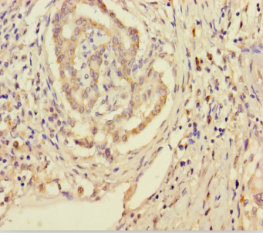
IHC application FFPE chromogenic IHC protocol Use this workflow for formalin-fixed, paraffin-embedded tissue sections with HRP/DAB or other chromogenic detection. Use this workflow when: Routine pathology-style protein localization in FFPE tissue using brightfield microscopy. Optimize first: Antigen retrieval buffer, LIPH Polyclonal Antibody dilution, detection chemistry, and chromogen development time. Deparaffinize and rehydrate Remove paraffin with xylene or substitute, then rehydrate through graded alcohols to water.Incomplete deparaffinization causes patchy staining. Perform antigen retrieval Use heat-induced epitope retrieval in citrate, EDTA, or another validated retrieval buffer.Choose retrieval pH based on antibody datasheet or optimization. Block endogenous activity Block endogenous peroxidase for HRP detection and block non-specific tissue binding.Use serum or protein blocker matched to the detection system. Incubate LIPH Polyclonal Antibody Apply IHC-validated LIPH Polyclonal Antibody at the recommended dilution and incubation time.Run positive and negative tissue controls. Detect, counterstain, and mount Add detection reagent, develop chromogen, counterstain, dehydrate if required, clear, and mount.Stop chromogen development before background becomes excessive.
IHC application Frozen tissue IHC protocol Use this workflow for frozen tissue sections when epitopes are sensitive to FFPE processing or when morphology and antigen preservation require gentler handling. Use this workflow when: Targets sensitive to FFPE processing, lipid-rich tissue, or cases where frozen preservation is preferred. Optimize first: Fixation method, tissue adherence, antibody penetration, and section background. Prepare sections Bring frozen sections to the recommended temperature and fix if not already fixed.Use acetone, methanol, or paraformaldehyde only if compatible with the target. Wash and block Wash gently and block non-specific binding.Handle sections carefully because frozen tissue can detach or tear. Apply LIPH Polyclonal Antibody Incubate with antibody validated for frozen tissue or IHC where possible. Add detection reagent Use chromogenic or fluorescent detection matched to the experimental goal. Counterstain and mount Counterstain appropriately and mount using medium compatible with detection method.
IHC application Fluorescent IHC protocol Use this workflow for tissue sections when fluorescence detection, co-localization, or multiplexing is needed. Use this workflow when: Co-localization, multiplex marker analysis, and fluorescence-based tissue imaging. Optimize first: Autofluorescence reduction, fluorophore selection, secondary antibody specificity, and exposure settings. Prepare tissue Use FFPE or frozen tissue preparation appropriate to the target and antibody. Retrieve and block Perform antigen retrieval if needed and block tissue background.Reduce autofluorescence if the tissue type requires it. Incubate primary antibodies Use validated primary antibodies and confirm species compatibility for multiplex staining. Add fluorescent secondaries Use cross-adsorbed fluorophore-conjugated secondary antibodies and protect from light. Mount and image Mount with anti-fade medium and acquire images with channel-specific exposure settings.
IHC application IHC antibody optimization workflow Use this workflow when an antibody has weak staining, high background, or uncertain IHC performance. Use this workflow when: New antibody setup, new tissue type, or transfer of a protocol to a new staining platform. Optimize first: Control tissue quality, retrieval conditions, antibody dilution, blocker, and detection time. Start with control tissue Use a known positive tissue and a known negative tissue before interpreting experimental samples. Titrate antigen retrieval Compare retrieval buffer pH and time without changing every variable at once. Titrate antibody dilution Test a small dilution series around the datasheet recommendation. Check detection background Run no-primary and isotype or negative reagent controls if appropriate. Lock the final protocol Once signal and background are acceptable, keep retrieval, antibody dilution, incubation time, and detection time consistent.
IF application Cultured Cell IF/ICC Protocol Use this workflow for immunofluorescence staining of cultured cells grown on coverslips, chamber slides, or imaging plates. This is the typical ICC workflow when fluorescent antibody detection is used. Use this workflow when: Subcellular localization, target expression patterns, co-localization, and cell-to-cell heterogeneity. Optimize first: Fixation, permeabilization, antibody dilution, secondary antibody specificity, and imaging exposure. Prepare and fix cells Grow cells to appropriate density, wash gently with PBS, and fix with paraformaldehyde or another validated fixative.Start with 4% paraformaldehyde for 10-15 minutes for many targets.Use cold methanol only when it preserves the target and epitope. Permeabilize if needed Permeabilize only when detecting intracellular or nuclear targets.Start with 0.1-0.3% Triton X-100 or saponin depending on target location.Skip or reduce permeabilization for surface antigens. Block non-specific binding Block with serum or protein blocker matched to the secondary antibody system.Use serum from the secondary antibody host species when appropriate.Use Fc block for immune cells when non-specific Fc binding is likely. Incubate primary and secondary antibodies Add LIPH Polyclonal Antibody at validated IF dilution, wash, then add fluorophore-conjugated secondary antibody protected from light.Include no-primary control.Use highly cross-adsorbed secondary antibodies for multiplex IF. Counterstain, mount, and image Add nuclear counterstain if needed, mount with anti-fade medium, and image using non-saturating exposure settings.Use the same exposure settings for comparison groups.
IF application Tissue immunofluorescence protocol Use this workflow for frozen or fixed tissue sections when fluorescent detection is preferred over chromogenic staining. Use this workflow when: Spatial localization of proteins in tissue sections with fluorescence-based detection. Optimize first: Tissue autofluorescence, antigen retrieval, blocking, and antibody penetration. Prepare tissue sections Bring sections to the correct temperature, outline tissue, and wash gently to remove storage medium or embedding residue. Fix or retrieve antigen Use fixation or antigen retrieval appropriate to the tissue preparation and target epitope.Frozen tissue often needs gentler fixation.Fixed tissue may require antigen retrieval. Reduce tissue background Block non-specific binding and reduce autofluorescence if tissue background is high.Include tissue-only and secondary-only controls. Incubate antibodies Apply LIPH Polyclonal Antibody, wash thoroughly, then add fluorophore-conjugated secondary antibody.Protect slides from light after fluorophore addition. Mount and image Counterstain nuclei if needed, mount with anti-fade medium, and image using matched settings across samples.
IF application Multiplex immunofluorescence protocol Use this workflow when detecting two or more targets in the same sample. Use this workflow when: Co-localization, pathway mapping, cell identity markers, and target expression in mixed populations. Optimize first: Species compatibility, fluorophore selection, bleed-through, and secondary antibody cross-reactivity. Plan antibody species and channels Select primary antibodies from different host species or use directly conjugated antibodies when species overlap.Choose fluorophores with minimal spectral overlap. Validate single stains first Run each antibody alone before combining them.Confirm expected localization and signal strength.Check bleed-through using single-color controls. Block and incubate antibodies Block carefully and incubate primary antibodies together only after individual staining is validated. Use cross-adsorbed secondaries Use highly cross-adsorbed secondary antibodies matched to each primary species.Add secondary-only controls for each channel. Acquire sequential images Image channels sequentially when possible and keep settings consistent for comparisons.
IF application Phospho or PTM immunofluorescence protocol Use this workflow for phosphorylation, acetylation, methylation, or other modification-specific antibody staining. Use this workflow when: Detecting activated signaling pathways, histone modifications, or other modification-specific targets in cells or tissue. Optimize first: Fixation timing, modification preservation, antibody specificity, and treatment controls. Preserve the modification Fix quickly and consistently. Use inhibitors during sample handling when appropriate. Choose fixation carefully Modification-specific epitopes can be sensitive to fixation conditions.Compare paraformaldehyde and methanol only if needed. Block and stain Use a blocker compatible with the antibody and modification.Use no-primary, untreated, and treated controls where possible. Validate specificity Compare signal with pathway stimulation, inhibitor treatment, enzyme treatment, knockdown, or known positive samples when possible. Image matched groups Use identical acquisition settings for treated and untreated groups.
ELISA format Sandwich ELISA protocol Use sandwich ELISA when the target can be captured by one antibody and detected by a second antibody that recognizes a different epitope. This format is commonly used for sensitive quantification of proteins in complex samples. Use this format when: Quantifying soluble proteins, cytokines, hormones, histones, modified proteins, or other targets where a matched antibody pair is available. Optimize first: Antibody pair compatibility, sample dilution, washing stringency, and standard curve range. Coat the capture antibody Dilute capture antibody in coating buffer and add to a high-binding ELISA plate. Incubate overnight at 4 C or for the validated coating time.Use matched antibody pairs when available.Keep coating volume consistent across wells. Block the plate Remove coating solution and block unoccupied binding sites with a validated blocking buffer.Start with 1-5% BSA, casein, or another ELISA-compatible blocker.Block long enough to reduce background without masking capture antibody activity. Add standards and samples Add standard curve, blanks, controls, and diluted samples. Incubate long enough for target binding.Run standards in duplicate or triplicate.Dilute complex samples to reduce matrix effects. Add detection antibody Add detection antibody that binds a different epitope than the capture antibody.Use biotinylated or enzyme-conjugated detection antibody when appropriate.Optimize detection antibody concentration if background is high. Develop and read Add enzyme conjugate if needed, wash thoroughly, add substrate, stop reaction, and read absorbance or signal according to the detection chemistry.Read within the recommended time window.Use the linear portion of the standard curve for quantification.
ELISA format Indirect ELISA protocol Use indirect ELISA to detect antibodies in a sample or to screen antibody binding against an immobilized antigen. Use this format when: Antibody screening, titer measurement, antigen binding tests, and immune response studies. Optimize first: Antigen coating level, sample dilution, secondary antibody dilution, and blocking buffer. Coat antigen Dilute purified antigen in coating buffer and add to the ELISA plate.Use enough antigen for binding without excessive non-specific background.Include uncoated or irrelevant-antigen wells. Block non-specific sites Block the plate with an ELISA-compatible blocker.Choose a blocker that does not cross-react with the sample antibody or secondary antibody. Add sample antibody Add serum, hybridoma supernatant, purified antibody, or other antibody-containing sample.Run a dilution series for unknown samples.Include positive and negative controls. Add enzyme-conjugated secondary antibody Add secondary antibody matched to the species and isotype of the sample antibody.Use cross-adsorbed secondary antibodies when specificity matters.Optimize secondary dilution to reduce background. Develop and interpret Add substrate, stop reaction if required, and read the plate.Compare signal to blank, negative control, and antigen-free wells.For screening, rank samples by signal-to-background ratio.
ELISA format Direct ELISA protocol Use direct ELISA when the assay format detects an immobilized target directly, such as a protein, peptide, small molecule, modified nucleoside, or other target presented in the well. This format is useful for direct target-detection workflows and kit formats built around direct detection. Use this format when: The target is detected directly from coated or immobilized material, including direct-detection kit formats, coating optimization, target screening, or assays where a directly labeled antibody or detection reagent is part of the workflow. Optimize first: Coating or immobilization conditions, sample dilution, blocking buffer, washing stringency, detection reagent concentration, and standard curve range. Coat or immobilize target Add purified target, lysate, sample, modified molecule, or kit-specified coating material to the plate and incubate under validated conditions. Block the plate Block wells to reduce non-specific binding.Include blank or background-control wells to measure plate and reagent background. Add direct detection reagent Add the kit-specified detection reagent, directly labeled antibody, or enzyme-conjugated antibody diluted in the recommended buffer.Start with datasheet or kit guidance and run a dilution series when optimizing a new assay. Wash thoroughly Wash enough to remove unbound detection reagent.High background is often improved by dilution, blocking, and wash optimization. Develop and read Add substrate, monitor color development, stop reaction if required, and read signal.
ELISA format Competitive ELISA protocol Use competitive ELISA when the target is small, has one dominant epitope, or cannot be measured easily by sandwich ELISA. Use this format when: Small molecules, peptides, modified epitopes, or targets with limited antibody-pair options. Optimize first: Competition timing, antibody concentration, standard curve range, and sample matrix effects. Set up competition format Choose whether sample target competes with coated antigen or labeled target for limited antibody binding.Keep the competition design consistent across standards and unknowns. Prepare standards and samples Prepare a standard curve covering the expected concentration range.Competitive ELISA signal often decreases as target concentration increases. Add antibody and competitor Incubate antibody with standards or samples according to the chosen competitive design. Wash and develop Wash the plate, add detection reagent or substrate as required, and read signal. Analyze correctly Fit the standard curve using the appropriate competitive model and interpret inverse signal behavior.Do not interpret competitive ELISA like sandwich ELISA.