 Our single B-cell derived recombinant rabbit monoclonal antibodies have vastly improved reliability and reproducibility.



 Cart (0)


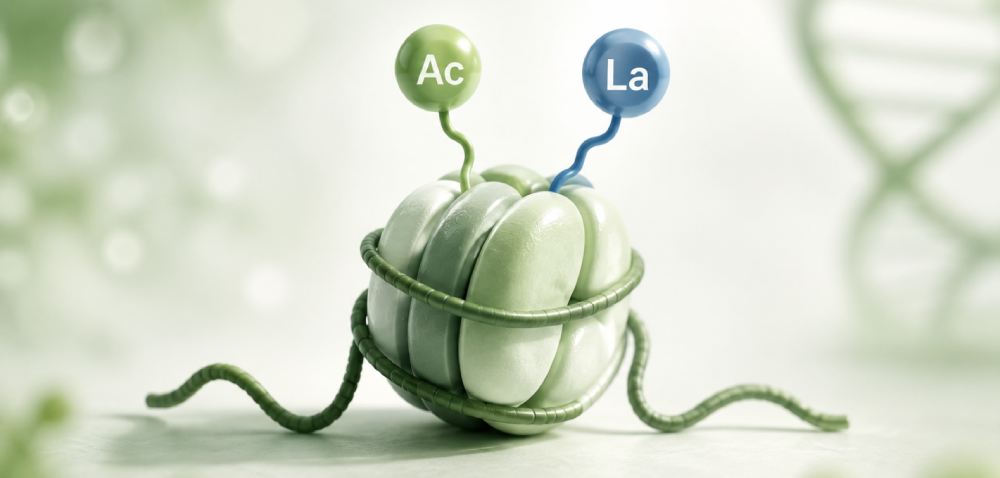
From metabolic perturbation to chromatin evidence
Metabolite measurements and chromatin readouts often move together. Interpretation becomes risky when an increase in lactate, a shift in H3K27ac, and a change in RNA expression are treated as one continuous mechanism. Each observation comes from a different biological layer, and the links between those layers must be demonstrated.
A strong study establishes the metabolic change, tests the activity of relevant writers and erasers, measures histone modification abundance, maps the mark across the genome, and then asks whether transcription follows. Missing steps do not invalidate the experiment, but they limit the claim. A global H3K27ac result supports a sample-wide change in that mark. It does not identify the enhancer, promoter, or gene responsible for the phenotype.
Acetyl-CoA supply is spatially organized
Histone acetyltransferases use acetyl-CoA available in the nucleus. Small metabolites can pass between the cytosol and nucleus through nuclear pores, so nuclear and cytosolic acetyl-CoA are not separated by an impermeable membrane. The main membrane barrier is mitochondrial: acetyl-CoA cannot directly cross the inner mitochondrial membrane, and its carbon is commonly exported as citrate before ATP-citrate lyase (ACLY) regenerates acetyl-CoA outside mitochondria. Nuclear production by enzymes such as acetyl-CoA synthetase 2 (ACSS2) can still raise acetyl-CoA availability near selected chromatin regions.
ACLY converts citrate into acetyl-CoA. Wellen and colleagues showed that ACLY depletion reduced histone acetylation and altered the expression of glucose-responsive genes, linking carbon use to chromatin regulation [1]. The result placed acetyl-CoA production upstream of a measurable transcriptional effect.
ACSS2 uses acetate. In neurons, nuclear ACSS2 associated with genes involved in learning and memory and supported local histone acetylation [2]. During nutrient stress, AMPK-dependent movement of ACSS2 into the nucleus supported lysosomal and autophagy gene expression, including reuse of acetate released during deacetylation [3].
Whole-cell metabolite abundance therefore cannot be assumed to predict acetylation at a specific locus. Nuclear localization, enzyme recruitment, substrate channeling, and chromatin context may separate a large metabolic pool from the fraction that reaches histone-modifying enzymes. Recent work in exhausted CD8+ T cells reached a similar conclusion: acetate and citrate metabolism, together with ACSS2 and ACLY use, contributed to distinct histone acetylation states and cell fates [4].
Acetylation is a biochemical endpoint with several possible causes
Histone lysine acetylation changes histone charge and creates binding sites for acetyl-lysine readers. The effect depends on the residue, genomic position, and associated protein complex. Increased acetylated H3 may reflect higher HAT activity, lower deacetylase activity, greater acetyl-CoA availability, altered histone turnover, or redistribution of acetylation to a limited set of loci.
The interpretation should remain proportional to the readout. Global assays are well suited to condition screening and treatment comparisons. Genomic methods are needed when the claim concerns a promoter, enhancer, or transcriptional program.
| Readout | Supports | Does not establish |
|---|---|---|
| Total H3 acetylation | A sample-wide change in acetylated H3 | The lysine site or genomic location |
| Global H3K27ac | A sample-wide change in H3K27ac abundance | Which promoter or enhancer changed |
| ChIP, CUT&RUN, or CUT&LUNCH | Genomic enrichment of the selected mark | Direct HAT or HDAC activity |
| RNA analysis | A transcriptional response | That a histone mark caused the response |
After a consistent histone preparation, the EpiQuik Total Histone H3 Acetylation Detection Fast Kit (P-4030) is suited to broad H3 acetylation screening. The EpiQuik Global Acetyl Histone H3K27 Quantification Kit (P-4059) narrows the measurement to global H3K27ac. The EpiQuik Histone H3 Modification Multiplex Assay Kit (P-3100) is useful when the treatment may alter several H3 marks and the first priority is pattern recognition. These assays measure abundance at the sample level; genomic localization requires a separate chromatin profiling method.
Histone lactylation: strong evidence, active questions
Histone lactylation entered the field as a metabolism-linked histone modification in 2019. Zhang and colleagues identified 28 histone lactylation sites in human and mouse cells. Hypoxia and bacterial stimulation increased cellular lactate and histone lactylation in their models [5]. In classically activated macrophages, lactylation accumulated later than the early acetylation response and coincided with expression of genes associated with homeostatic and wound-healing functions, including Arg1.
The timing made lactylation an attractive explanation for late transcriptional responses to glycolytic activation. Lactate concentration alone, however, does not measure histone lactylation. The proposed mechanism also depends on formation of an activated donor, entry into the nuclear pool, transfer to lysine, removal by deacylases, histone turnover, and recruitment to particular genomic regions.
Enzyme studies have begun to define this chemistry. Moreno-Yruela and colleagues identified HDAC1, HDAC2, and HDAC3 as histone lysine delactylases and found that class I HDACs made an important cellular contribution [6]. More recent work has proposed lactyl-CoA synthesis in glioma models. One study linked ACSS2 with lactyl-CoA production and KAT2A-dependent lactylation [7]. Another identified nuclear GTPSCS as a lactyl-CoA synthetase that cooperated with p300 and increased H3K18 lactylation [8]. These mechanisms were demonstrated in specific disease settings and need direct testing before they are extended to other cell types.
Lactylation may also persist after the initiating metabolic event. A 2025 study of innate immune memory detected H3K18 lactylation at active distal regulatory regions and reported persistence for up to 90 days after BCG vaccination in the studied in vivo setting [9]. The observation supports a possible role in longer-lived chromatin states, while leaving open how broadly that persistence applies.
Build the experiment around the causal sequence
Control the metabolic context and sampling windowRecord glucose, acetate, lactate, glutamine, oxygen conditions, media buffering, cell density, treatment duration, and collection time. Extracellular lactate treatments need pH and osmolality controls. Viability and proliferation should be tracked because cell loss, growth arrest, and cell-cycle redistribution can alter chromatin independently of the proposed metabolic mechanism.
A time course is usually more informative than a single endpoint. Acetylation may change rapidly as acetyl-CoA supply or deacetylase activity shifts. Lactylation and RNA responses may develop later. Sampling several points can establish order and prevent a late event from being assigned as the cause of an earlier one.
Keep histone preparation constantExtraction variability can obscure a real treatment effect or create an apparent one. Starting material, processing time, temperature, extraction chemistry, and storage should remain matched across groups. The EpiQuik Total Histone Extraction Kit (OP-0006) offers a common total-histone preparation for mammalian cells and tissues and can feed the acetylation and H3 modification assays described in this workflow.
Screen the mark before narrowing the mechanismBegin with the readout that matches the biological hypothesis. A broad shift in H3 acetylation can be screened with P-4030. A study centered on enhancer-associated acetylation may begin with global H3K27ac using P-4059. P-3100 is more useful when the treatment may affect several H3 acetylation, methylation, or phosphorylation states. The screen should identify the conditions and time points worth taking into deeper chromatin analysis.
Measure enzyme activity as a separate variableMark abundance is the accumulated result of deposition, removal, substrate supply, localization, and turnover. It is not an enzyme activity measurement. The EpiQuik HAT Activity/Inhibition Assay Kit (P-4003) can assess total histone acetyltransferase activity, while the Epigenase HDAC Activity/Inhibition Direct Assay Kit (P-4034) can assess total histone deacetylase activity. Pairing these results with histone acetylation helps distinguish a change in catalytic balance from a change that may arise through acetyl-CoA availability or chromatin recruitment.
| Observed pattern | Reasonable interpretation | Follow-up |
|---|---|---|
| Higher H3 acetylation with stable HAT and HDAC activity | Substrate availability, localization, or histone turnover may contribute | Measure metabolites and map acetylation |
| Higher HAT activity with higher acetylation | Greater acetyl group deposition is consistent with the phenotype | Test candidate HAT recruitment or inhibition |
| Lower HDAC activity with higher acetylation | Reduced removal may contribute | Resolve HDAC class or isoform involvement |
| Stable global acetylation with local H3K27ac gains | Redistribution may be more important than total abundance | Use ChIP, CUT&RUN, or CUT&LUNCH with RNA analysis |
Once the global screen identifies a reproducible condition, ChIP, CUT&RUN, or CUT&LUNCH can locate the change. The choice depends on sample amount, background, throughput, and the required resolution. Quantitative ChIP methods also remain useful for controlled multi-sample comparisons. The MINUTE-ChIP workflow, for example, was described for quantitative profiling of 12 samples against multiple chromatin epitopes in approximately one week [10].
RNA-seq or targeted expression analysis should be collected from the same biological context. Concordance among metabolite measurements, enzyme activity, histone mark abundance, genomic localization, and gene expression creates a coherent mechanism. Discordance is also informative. It may indicate that the treatment changed metabolism without changing chromatin, shifted acetylation without affecting the selected genes, or altered transcription through a different pathway.
Interpretation checks that prevent overclaiming
- H3K27ac is not an accessibility assay. H3K27ac and chromatin accessibility often correlate, but accessibility should be measured directly with ISAC-seq or another suitable method.
- Lactate is not a lactylation measurement. An increase in lactate supports the metabolic context. Direct histone lactylation data are still required.
- A global assay does not identify a genomic locus. Sample-wide abundance and locus-specific enrichment should be reported as separate results.
- Mark abundance is not enzyme activity. HAT and HDAC assays test catalytic behavior, while histone modification assays measure the accumulated product in the sample.
- A single time point can misorder the mechanism. Metabolites, histone modifications, and RNA may peak at different times.
EpigenTek product selector
| Product | Best fit in the workflow |
|---|---|
| EpiQuik Histone H3 Modification Multiplex Assay Kit (P-3100) | Broad H3 modification screening when the affected mark is not yet clear |
| EpiQuik Total Histone H3 Acetylation Detection Fast Kit (P-4030) | Condition-level screening of total H3 acetylation |
| EpiQuik Global Acetyl Histone H3K27 Quantification Kit (P-4059) | Focused measurement of global H3K27ac |
| EpiQuik HAT Activity/Inhibition Assay Kit (P-4003) | Total HAT activity or inhibition |
| Epigenase HDAC Activity/Inhibition Direct Assay Kit (P-4034) | Total HDAC activity or inhibition |
| EpiQuik Total Histone Extraction Kit (OP-0006) | Total histone preparation from mammalian cells or tissues |
Metabolic control of chromatin is best studied as a chain of linked measurements. Acetyl-CoA production, lactate metabolism, writer and eraser activity, nuclear localization, and genomic targeting can all shape the final chromatin state. No single readout resolves the entire sequence.
Histone acetylation remains the most established entry point because its substrate, enzymes, and genomic associations are comparatively well defined. Histone lactylation adds a compelling layer in hypoxia, immunity, cancer, and other settings with altered glycolysis. Its interpretation requires direct detection and careful separation from acetylation changes that may occur in parallel.
Claims should stay matched to the measurement. Global assays establish sample-wide changes. Enzyme assays test catalytic balance. ChIP, CUT&RUN, and CUT&LUNCH locate chromatin enrichment. RNA analysis shows the transcriptional outcome. When these results align in time and direction, a metabolism-linked chromatin mechanism becomes much harder to dismiss as correlation.
References- Wellen KE, Hatzivassiliou G, Sachdeva UM, Bui TV, Cross JR, Thompson CB. ATP-citrate lyase links cellular metabolism to histone acetylation. Science. 2009;324(5930):1076-1080. doi:10.1126/science.1164097. View article
- Mews P, Donahue G, Drake AM, Luczak V, Abel T, Berger SL. Acetyl-CoA synthetase regulates histone acetylation and hippocampal memory. Nature. 2017;546(7658):381-386. doi:10.1038/nature22405. View article
- Li X, Yu W, Qian X, et al. Nucleus-Translocated ACSS2 Promotes Gene Transcription for Lysosomal Biogenesis and Autophagy. Mol Cell. 2017;66(5):684-697.e9. doi:10.1016/j.molcel.2017.04.026. View article
- Ma S, Dahabieh MS, Mann TH, et al. Nutrient-driven histone code determines exhausted CD8+ T cell fates. Science. 2025;387(6734):eadj3020. doi:10.1126/science.adj3020. View article
- Zhang D, Tang Z, Huang H, et al. Metabolic regulation of gene expression by histone lactylation. Nature. 2019;574(7779):575-580. doi:10.1038/s41586-019-1678-1. View article
- Moreno-Yruela C, Zhang D, Wei W, et al. Class I histone deacetylases (HDAC1-3) are histone lysine delactylases. Sci Adv. 2022;8(3):eabi6696. doi:10.1126/sciadv.abi6696. View article
- Zhu R, Ye X, Lu X, et al. ACSS2 acts as a lactyl-CoA synthetase and couples KAT2A to function as a lactyltransferase for histone lactylation and tumor immune evasion. Cell Metab. 2025;37(2):361-376.e7. doi:10.1016/j.cmet.2024.10.015. View article
- Liu R, Ren X, Park YE, et al. Nuclear GTPSCS functions as a lactyl-CoA synthetase to promote histone lactylation and gliomagenesis. Cell Metab. 2025;37(2):377-394.e9. doi:10.1016/j.cmet.2024.11.005. View article
- Ziogas A, Novakovic B, Ventriglia L, et al. Long-term histone lactylation connects metabolic and epigenetic rewiring in innate immune memory. Cell. 2025;188(11):2992-3012.e16. doi:10.1016/j.cell.2025.03.048. View article
- Kumar B, Navarro C, Yung PYK, et al. Multiplexed chromatin immunoprecipitation sequencing for quantitative study of histone modifications and chromatin factors. Nat Protoc. 2025;20(3):779-809. doi:10.1038/s41596-024-01058-z. View article



