Choose the catalog number and quantity to pre-fill on the quote request page.
BackgroundFunctions in nuclear protein import as nuclear transport receptor. Serves as receptor for nuclear localization signals (NLS) in cargo substrates. Is thought to mediate docking of the importin/substrate complex to the nuclear pore complex (NPC) through binding to nucleoporin and the complex is subsequently translocated through the pore by an energy requiring, Ran-dependent mechanism. At the nucleoplasmic side of the NPC, Ran binds to the importin, the importin/substrate complex dissociates and importin is re-exported from the nucleus to the cytoplasm where GTP hydrolysis releases Ran. The directionality of nuclear import is thought to be conferred by an asymmetric distribution of the GTP- and GDP-bound forms of Ran between the cytoplasm and nucleus. Mediates the nuclear import of UBC9, the RBM8A/MAGOH complex, PAX6 and probably other members of the paired homeobox family. Also mediates nuclear export of eIF-1A, and the cytoplasmic release of eIF-1A is triggered by the loading of import substrates onto IPO13.
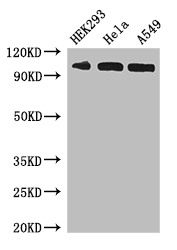
DescriptionIPO13 Polyclonal Antibody, HRP Conjugated. HRP. Raised in: Rabbit.
FormulationLiquid. 0.03% Proclin 300, 50% Glycerol, 0.01M PBS, PH 7.4.
SpecificityHuman
IsotypeIgG
Uniprot IDO94829
Purification>95%, Protein G purified
ImmunogenRecombinant Human Importin-13 protein (501-700AA)
StorageShipped at 4°C. Upon delivery aliquot and store at -20°C (short-term) or -80°C (long-term). Avoid repeated freeze.
Alternative NamesImportin-13, Imp13, Karyopherin-13, Kap13, Ran-binding protein 13, RanBP13, IPO13, KIAA0724, RANBP13
ApplicationELISA; Recommended dilution: ELISA 1:500-1:1000