 Our single B-cell derived recombinant rabbit monoclonal antibodies have vastly improved reliability and reproducibility.



 Cart (0)


Antibody-based chromatin profiling has moved far beyond conventional ChIP-seq. Researchers now have access to faster, lower-input methods that map histone modifications, transcription factors, RNA polymerase II, and other chromatin-associated proteins with higher signal-to-background performance than many legacy immunoprecipitation workflows.
The challenge is that method choice has become more complicated. CUT&RUN and CUT&Tag both improved on ChIP-seq by using antibody-guided in situ enzyme activity, but each workflow has practical tradeoffs. CUT&RUN can generate clean profiles with low sequencing depth, yet it can require careful handling of nuclease conditions, bead immobilization, and released chromatin fragments. CUT&Tag is highly efficient and can streamline library generation, yet its dependence on Tn5 tagmentation can make accessibility-related bias an important consideration. CUT&LUNCH is positioned as a rapid, antibody-based chromatin profiling workflow that combines antibody-directed target enrichment with controlled cleavage and selective recovery of target protein-DNA complexes.
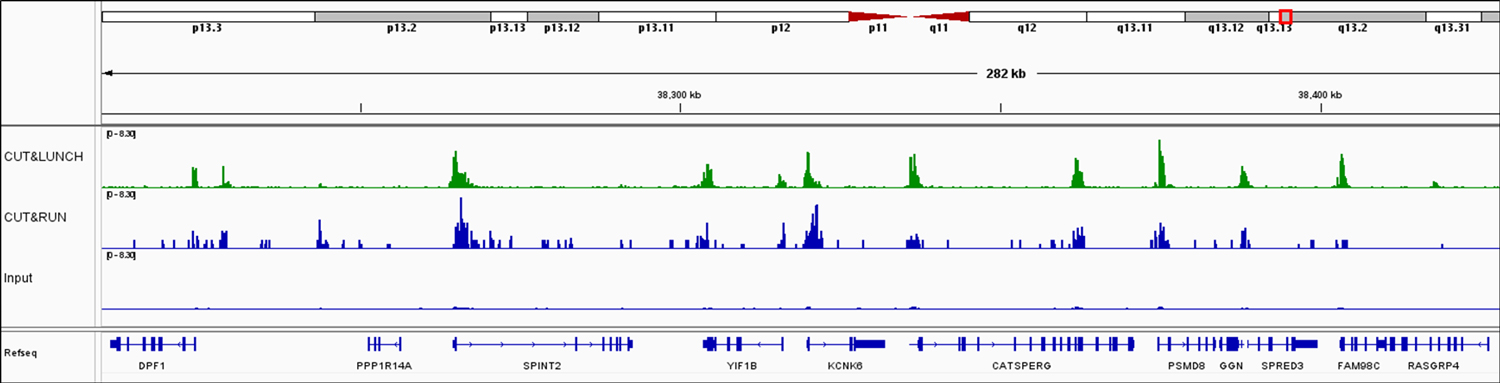
CUT&LUNCH outperforms CUT&RUN. Peak scores are plotted in the bar graph for 100,000 MCF-7 cells using the CUT&LUNCH assay kit, followed by NGS for histone H3K4me3. CUT&LUNCH shows lower background noise and narrower peaks.
The central question for researchers is not simply "Which method is newest?" It is "Which method best matches the sample, target, output, and interpretation risk?" A histone mark in abundant cultured cells, a transcription factor in rare primary cells, and a targeted qPCR validation experiment may all require different workflow choices.
For researchers comparing these workflows, EpigenTek supports the major decision points across antibody-based chromatin profiling: CUT&LUNCH for rapid target enrichment, CUT&LUNCH-Seq for sequencing-ready workflows, ChIP for orthogonal validation, chromatin accessibility analysis for interpretation support, and chromatin extraction for upstream sample preparation.
Choosing the right workflow
Choose CUT&LUNCH when speed, low input, and selective recovery are high priorities. It is particularly useful for researchers who want targeted qPCR readouts or NGS-compatible enriched DNA without the full complexity of traditional CUT&RUN or CUT&Tag workflows.
Choose CUT&LUNCH-Seq when the output must be sequencing-ready libraries and the team wants a streamlined route from cells to library DNA. This is especially relevant for projects comparing histone marks, RNA polymerase II, or strong-binding transcription factors across multiple low-input samples.
Choose CUT&RUN when a lab has established nuclease-based workflows and wants high-resolution, low-background mapping with careful digestion control.
Choose CUT&Tag when the project emphasizes efficient library generation, scalable epigenomic profiling, or single-cell adaptation, while accounting for Tn5-related sequence and accessibility bias during experimental design and analysis.
Choose ChIP or high-sensitivity ChIP when the project requires crosslinked chromatin, continuity with legacy datasets, or orthogonal validation of results from newer methods.
How do CUT&LUNCH, CUT&RUN, and CUT&Tag differ?
CUT&RUN uses an antibody to localize a protein A or protein A/G micrococcal nuclease fusion to the target chromatin protein. Calcium activation releases nearby DNA fragments for downstream sequencing or qPCR. It is known for low background and high resolution, with the original report noting that CUT&RUN required roughly one-tenth the sequencing depth of ChIP for many targets [1].
CUT&Tag uses an antibody to tether pA-Tn5 or pAG-Tn5 transposase to the target. Tn5 simultaneously cleaves and inserts sequencing adaptors, making library generation efficient. CUT&Tag is especially attractive for low-input and single-cell epigenomics, and the initial publication demonstrated profiling of histone marks, RNA polymerase II, and transcription factors in small samples and single cells [5].
CUT&LUNCH, short for Cleavage Under Target and Liberate Unique Nucleic Complex Homogeneously, uses antibody-directed target recognition with a cleavage strategy designed to cut DNA at both ends of target protein-DNA complexes, remove non-target DNA, and selectively recover antibody-bound complexes. The goal is to retain the low-input and high-resolution advantages of modern in situ methods while simplifying the workflow and reducing non-specific background before downstream qPCR or NGS.
A workflow-level comparison
| Practical question | CUT&RUN | CUT&Tag | CUT&LUNCH |
|---|---|---|---|
| Core enzyme strategy | Antibody-tethered MNase cleavage | Antibody-tethered Tn5 tagmentation | Antibody-guided cleavage and selective recovery of target protein-DNA complexes |
| Common output | qPCR or sequencing after released DNA recovery | Sequencing-ready libraries after tagmentation and PCR | qPCR or NGS-compatible enriched DNA; CUT&LUNCH-Seq includes library prep |
| Key strength | Low background and high resolution with reduced sequencing depth | Efficient library generation, low input, scalable to single-cell formats | Rapid workflow, selective recovery, low-input compatibility, reduced non-specific background |
| Main interpretation concern | Nuclease digestion conditions and release efficiency can affect signal | Tn5 sequence/accessibility preferences can affect read distribution | As with all antibody-based methods, antibody quality and target biology remain critical |
| Best fit | Clean mapping when nuclease-based release is optimized | Large-scale epigenomic profiling and single-cell applications | Fast targeted or genome-wide profiling when workflow speed, specificity, and low input are priorities |
CUT&RUN: strong signal-to-noise, but digestion and release still matter
CUT&RUN was a major advance because it moved chromatin profiling away from the heavy crosslinking, sonication, and immunoprecipitation steps that make many ChIP-seq experiments labor-intensive. By targeting MNase activity directly to antibody-bound sites, CUT&RUN can produce short DNA fragments centered around the target protein. This improves resolution and reduces background relative to conventional ChIP-seq.
The original CUT&RUN work reported high-resolution mapping of DNA-binding proteins with low background and reduced sequencing depth compared with ChIP [1]. A later Nature Protocols paper described targeted in situ genome-wide profiling for low cell numbers [2], and improved CUT&RUN tools expanded antibody compatibility through protein A/G-MNase and refined digestion conditions [3]. Because CUT&RUN often produces sparse, focused enrichment patterns rather than broad ChIP-like background, analysis strategy also matters. Sparse Enrichment Analysis was developed specifically for CUT&RUN peak calling to help identify enriched regions from low-background CUT&RUN data [4].
The practical caveat is that CUT&RUN performance depends on controlled nuclease access, antibody performance, cell or nuclei handling, and fragment recovery. For abundant histone marks, the method can be highly robust. For lower-abundance transcription factors or targets in difficult samples, researchers may need to optimize permeabilization, antibody concentration, digestion time, salt conditions, and release conditions. Some experiments also require careful interpretation of non-specific cleavage or background released by enzyme complexes that are not productively bound to the intended target.
This is where CUT&LUNCH can be useful for teams that want the benefits of antibody-guided chromatin profiling with a more streamlined recovery strategy. The EpiNext CUT&LUNCH Assay Kit (P-2035) fits this type of workflow when the goal is fast target enrichment for qPCR or downstream sequencing analysis.
CUT&Tag: efficient library generation, with open chromatin bias to watch
CUT&Tag is widely adopted because it directly couples target recognition to tagmentation. After antibody binding and Tn5 tethering, activation of Tn5 cleaves DNA and inserts sequencing adaptors in the same general process. This makes CUT&Tag highly efficient and well suited to low-input chromatin profiling. The 2019 Nature Communications paper demonstrated CUT&Tag for histone modifications, RNA polymerase II, transcription factors, low cell numbers, and single cells [5]. A later Nature Protocols article presented an efficient low-cost CUT&Tag protocol and emphasized streamlined library generation [6].
CUT&Tag also became a foundation for single-cell chromatin modification profiling. A 2024 Nature Protocols sciCUT&Tag workflow used combinatorial indexing and nanowell handling to scale single-cell profiling of chromatin modifications, illustrating how tagmentation-based profiling can support high-throughput epigenomics [7].
However, Tn5 is not a neutral enzyme. It has sequence and accessibility preferences. Recent work on PATTY, a computational correction method for CUT&Tag data, reported that Tn5 preference toward accessible chromatin can distort genome-wide signal patterns and that open-chromatin bias was present across published CUT&Tag datasets, including datasets generated with optimized high-salt protocols [8]. A 2025 benchmark study also observed a strong correlation between CUT&Tag signal intensity and chromatin accessibility, while noting that method choice should be tailored to the chromatin-protein interaction under study [9].
This does not mean CUT&Tag is unreliable. It means CUT&Tag data should be interpreted with awareness of chromatin accessibility, especially for sparse single-cell data, low-abundance targets, or comparisons involving large chromatin-state differences. For projects that require an NGS-ready workflow but where Tn5-related accessibility bias is a concern, CUT&LUNCH-Seq offers a practical non-Tn5 alternative. The EpiNext CUT&LUNCH-Seq Kit (P-2033) is suited for low-input chromatin profiling projects that need an integrated path from target enrichment to sequencing library preparation.
CUT&LUNCH: a focused response to speed, specificity, and low input
CUT&LUNCH is built around a practical idea: improve antibody-based chromatin profiling by controlling which DNA is cleaved, which DNA is removed, and which protein-DNA complexes are recovered. In the CUT&LUNCH workflow, cells are permeabilized and exposed to a ChIP-grade antibody. A nucleic acid cleavage enzyme mix cleaves DNA at both ends of target chromatin regions. Non-specific protein-DNA complexes are removed, and antibody-bound complexes are selectively recovered. The purified DNA can then be used for gene-specific qPCR or library construction.
In practice, CUT&LUNCH is best positioned for researchers who want a rapid, low-input workflow with selective recovery of antibody-bound protein-DNA complexes. P-2035 supports qPCR-based validation or NGS-compatible downstream analysis, while P-2033 extends the same general approach into a sequencing-focused workflow.
The strategic advantage is not only speed. Faster workflows can reduce sample handling time, help preserve limited material, and make replicate design more realistic. For researchers working with rare cell populations, primary cells, or multiple perturbation time points, shorter processing time can directly improve project feasibility.
When conventional ChIP still matters
Although CUT&LUNCH, CUT&RUN, and CUT&Tag are powerful, conventional ChIP remains useful. Some projects require comparison to legacy ChIP-seq datasets. Others involve targets or antibodies that have been validated primarily in ChIP. Crosslinked ChIP can also help stabilize transient or indirect protein-DNA interactions, although crosslinking and sonication can introduce their own sources of variability.
Conventional ChIP still has an important role when researchers need crosslinked chromatin data, continuity with legacy datasets, or orthogonal validation. The EpiQuik Chromatin Immunoprecipitation (ChIP) Kit (P-2002) and ChromaFlash High-Sensitivity ChIP Kit (P-2027) provide complementary ChIP options for these situations.
Use chromatin accessibility as an interpretation control, not a substitute for occupancy
A recurring issue in modern chromatin profiling is the relationship between protein occupancy and chromatin accessibility. Open chromatin is easier for enzymes and proteins to access, but an accessible region is not automatically enriched for a specific histone mark or transcription factor. Conversely, a region with a target histone modification may not behave like a highly accessible promoter or enhancer in every cell type.
This distinction matters most when comparing CUT&Tag data across conditions with broad chromatin accessibility differences. If a perturbation changes accessibility globally or at a subset of regulatory elements, a tagmentation-based readout may partly reflect enzyme access, not only antibody-targeted enrichment.
The EpiQuik Chromatin Accessibility Assay Kit (P-1047) can support this kind of orthogonal interpretation. It provides gene-specific chromatin accessibility analysis by qPCR using nuclease digestion and included positive and negative control primer sets. In a practical workflow, P-1047 can help determine whether a locus showing changed CUT&Tag or CUT&LUNCH signal also shows altered accessibility. That comparison can help separate target occupancy changes from broader changes in nucleosome positioning or chromatin compaction.
Sample preparation still determines data quality
The quality of any antibody-based chromatin assay depends on sample preparation. Cell integrity, nuclei handling, chromatin preservation, antibody accessibility, and DNA recovery all influence the final profile. Poor input material can make even the best method look noisy.
For projects that include conventional ChIP or chromatin-based orthogonal assays, the ChromaFlash Chromatin Extraction Kit (P-2001) provides a rapid method for isolating chromatin or DNA-protein complexes from mammalian cells or tissues. It is suitable for preparing native or crosslinked chromatin and can be used upstream of multiple chromatin immunoprecipitation workflows. This makes it useful when a project combines modern in situ methods with conventional ChIP validation, protein-DNA binding assays, or nuclear enzyme assays.
Product selector for chromatin profiling workflows
| Research need | Relevant product | Product fit | Note |
|---|---|---|---|
| Fast antibody-based enrichment for qPCR or NGS-compatible DNA | EpiNext CUT&LUNCH Assay Kit (P-2035) | CUT&LUNCH profiling from mammalian cells | Designed for histone or strong-binding transcription factor DNA complexes; supports qPCR or NGS-compatible downstream analysis |
| CUT&LUNCH with integrated library preparation | EpiNext CUT&LUNCH-Seq Kit (P-2033) | Genome-wide sequencing workflow | Designed for low-input cell samples and Illumina-compatible NGS library preparation |
| High-sensitivity ChIP for lower-abundance targets or orthogonal validation | ChromaFlash High-Sensitivity ChIP Kit (P-2027) | ChIP-qPCR, ChIP-on-chip, or ChIP-seq validation | Useful when conventional ChIP sensitivity and reduced background are priorities |
| Standard ChIP workflow | EpiQuik Chromatin Immunoprecipitation (ChIP) Kit (P-2002) | Conventional ChIP-based target enrichment | Supports PCR, DNA sequencing, Southern blot, DNA microarray, and other downstream analyses |
| Gene-specific chromatin accessibility analysis | EpiQuik Chromatin Accessibility Assay Kit (P-1047) | Orthogonal accessibility readout | Helps determine whether changes in profiling signal may coincide with local accessibility changes |
| Chromatin or DNA-protein complex preparation | ChromaFlash Chromatin Extraction Kit (P-2001) | Upstream chromatin extraction for ChIP-related workflows | Supports preparation of chromatin from mammalian cells or tissues for downstream chromatin applications |
References
- Skene PJ, Henikoff S. An efficient targeted nuclease strategy for high-resolution mapping of DNA binding sites. Elife. 2017;6:e21856. Published 2017 Jan 16. doi:10.7554/eLife.21856. View article
- Skene PJ, Henikoff JG, Henikoff S. Targeted in situ genome-wide profiling with high efficiency for low cell numbers. Nat Protoc. 2018;13(5):1006-1019. doi:10.1038/nprot.2018.015. View article
- Meers MP, Bryson TD, Henikoff JG, Henikoff S. Improved CUT&RUN chromatin profiling tools. Elife. 2019;8:e46314. Published 2019 Jun 24. doi:10.7554/eLife.46314. View article
- Meers MP, Tenenbaum D, Henikoff S. Peak calling by Sparse Enrichment Analysis for CUT&RUN chromatin profiling. Epigenetics Chromatin. 2019;12(1):42. Published 2019 Jul 12. doi:10.1186/s13072-019-0287-4. View article
- Kaya-Okur HS, Wu SJ, Codomo CA, et al. CUT&Tag for efficient epigenomic profiling of small samples and single cells. Nat Commun. 2019;10(1):1930. Published 2019 Apr 29. doi:10.1038/s41467-019-09982-5. View article
- Kaya-Okur HS, Janssens DH, Henikoff JG, Ahmad K, Henikoff S. Efficient low-cost chromatin profiling with CUT&Tag. Nat Protoc. 2020;15(10):3264-3283. doi:10.1038/s41596-020-0373-x. View article
- Janssens DH, Greene JE, Wu SJ, et al. Scalable single-cell profiling of chromatin modifications with sciCUT&Tag. Nat Protoc. 2024;19(1):83-112. doi:10.1038/s41596-023-00905-9. View article
- Hu SS, Su Z, Liu L, et al. PATTY corrects open-chromatin bias for improved bulk and single-cell CUT&Tag profiling. Nat Commun. Published online May 22, 2026. doi:10.1038/s41467-026-73599-8. View article
- Wang R, Wu Y, Zhou Z, et al. Benchmark of chromatin-protein interaction methods in haploid round spermatids. Front Cell Dev Biol. 2025;13:1572405. Published 2025 May 13. doi:10.3389/fcell.2025.1572405. View article



