 Our single B-cell derived recombinant rabbit monoclonal antibodies have vastly improved reliability and reproducibility.



 Cart (0)


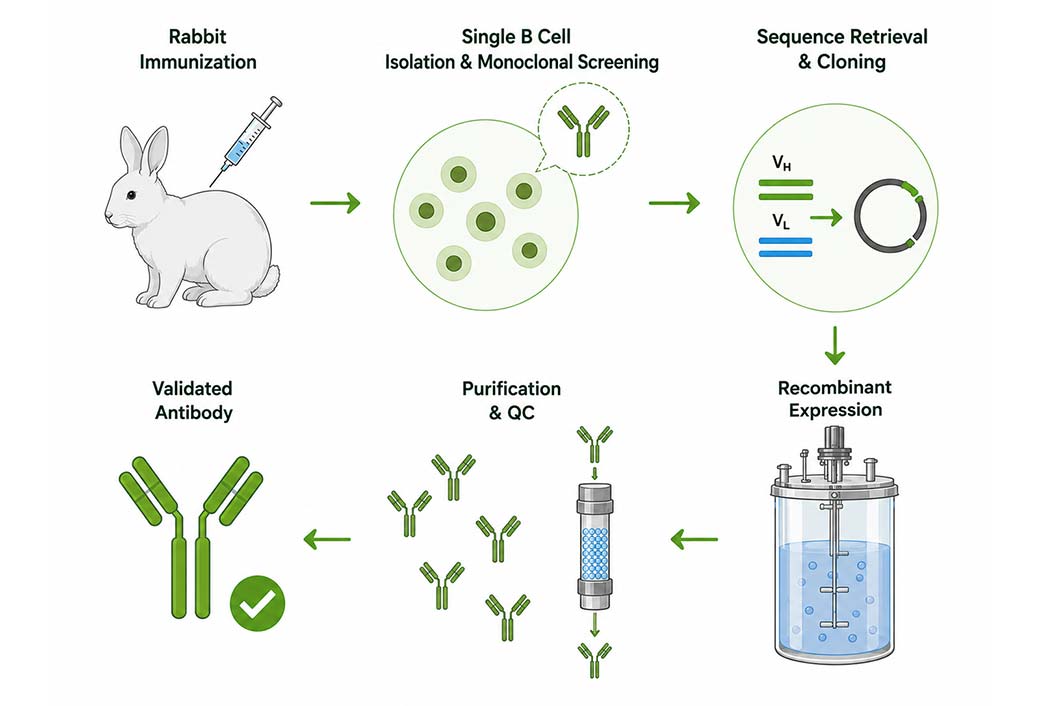
Antibodies are often treated as interchangeable detection reagents. In practice, the antibody itself can be one of the largest uncontrolled variables in an experiment. Two products directed against the same target may differ substantially in epitope recognition, affinity, cross-reactivity, working concentration, and performance in fixed, denatured, or native samples. Even a familiar clone may change when production depends on a living cell line, an incompletely defined antibody mixture, or a replacement lot generated through a new immunization.
These problems affect more than background staining. They can determine whether a weakly expressed protein is detected, whether a chromatin immunoprecipitation experiment enriches the correct genomic regions, whether an immunohistochemistry signal reflects the expected tissue distribution, and whether another laboratory can reproduce the result.
Recombinant rabbit monoclonal antibodies address this problem at two important levels. First, antigen-specific antibodies can be recovered directly from individual rabbit B cells, preserving the natural heavy-chain and light-chain pairing generated during the immune response. Second, the selected antibody sequence is transferred into a recombinant expression system, establishing a defined molecular identity that can be reproduced without continued dependence on the original B cell or hybridoma.
This combination distinguishes single B-cell-derived recombinant rabbit monoclonal antibodies from conventional hybridoma products, polyclonal sera, and recombinant antibodies created only after a hybridoma clone has already been selected. For many research applications, it provides a strong foundation for antibody specificity, sensitivity, and long-term reproducibility.
The practical limits of traditional antibody production
Hybridoma technology transformed biology by making it possible to produce monoclonal antibodies continuously from immortalized antibody-secreting cells. The method remains valuable and has contributed to thousands of research, diagnostic, and therapeutic reagents. Its limitations, however, are built into the workflow.
In a traditional hybridoma program, B cells from an immunized animal are fused with myeloma cells. Only a fraction of the original B-cell population successfully fuses, survives selection, proliferates, and secretes enough antibody to be screened. The final collection of hybridomas therefore represents a biologically selected subset of the immune response rather than its full antibody diversity.
A promising B cell can be lost because it does not fuse efficiently or because the resulting hybridoma grows poorly. Conversely, a rapidly growing hybridoma may be retained even when another antibody in the original immune repertoire would have produced cleaner or more sensitive assay results. The discovery pool is shaped partly by cell-culture fitness rather than antibody performance alone.
The assumption that each hybridoma necessarily produces one unique heavy-chain and light-chain combination also deserves scrutiny. Sequence analysis of 185 hybridomas found that additional productive variable-region transcripts were sufficiently common to challenge the routine equation of “hybridoma-derived” with fully defined molecular monospecificity [1]. Additional chains can complicate sequence recovery and recombinant conversion, particularly when the functional heavy-chain and light-chain pair has not been established experimentally.
Long-term dependence on a living cell line creates another point of vulnerability. Hybridomas may change in productivity, accumulate genetic alterations, or be lost through contamination, handling errors, or storage problems. A frozen cell bank reduces these risks but does not provide the same level of identity control as a verified antibody sequence.
Polyclonal antibodies have a different set of limitations. Their recognition of multiple epitopes can be helpful when antigen abundance is low or individual epitopes are partially masked. However, a polyclonal product is a changing mixture of antibodies. Once the original serum is depleted, a new immunization cannot recreate the same clonal composition. This is a major source of lot-to-lot variability [2,3].
Single B-cell discovery preserves the antibody selected in vivo
Single B-cell technologies begin closer to the biological source of the antibody. After immunization, antigen-specific B cells are identified and isolated individually. The immunoglobulin heavy-chain and light-chain genes are recovered from the same cell, cloned into expression vectors, and expressed as a complete recombinant antibody [4-6].
Preserving this pairing is important. Antigen recognition is created by the combined three-dimensional surface of the heavy-chain and light-chain variable regions. Replacing either chain can alter affinity, specificity, stability, or cross-reactivity. Recovering both genes from the same B cell retains the pairing that survived immune selection and affinity maturation in the animal.
Single-cell isolation also avoids the fusion bottleneck. Candidate antibodies do not need to form stable hybridomas before they can be examined. This gives antibody developers access to a broader portion of the antigen-responsive B-cell repertoire and allows selection to focus more directly on useful experimental properties.
Seeber and colleagues demonstrated a high-throughput workflow in which rabbit B cells from peripheral blood were isolated, their antibody genes were recovered, and recombinant monoclonal antibodies were screened for function [5]. This approach showed that useful rabbit antibodies could be generated without relying on hybridoma fusion and that naturally paired sequences could be moved rapidly into recombinant production.
Modern single B-cell platforms may incorporate antigen labeling, flow cytometry, microfluidics, single-cell sequencing, or short-term B-cell culture. The exact workflow varies, but the essential advantage remains the same: the antibody is captured from one antigen-responsive B cell, and its native heavy-chain and light-chain relationship is retained.
Why rabbits are especially productive antibody sources
Recombinant production provides sequence control, but it does not determine the biological diversity of the starting immune response. The host species still matters.
Rabbits have long been used for antibody generation because they can produce strong responses against many proteins, peptides, post-translational modifications, and conserved mammalian targets. Their antibody repertoire is generated through mechanisms that differ from those used in mice, including extensive somatic diversification. This biology can produce binding sites with structural and sequence characteristics that are less readily accessed through conventional murine immunization [7].
The practical result is a larger opportunity to identify antibodies against difficult epitopes. These may include:
- Small or poorly immunogenic antigens
- Highly conserved mammalian proteins
- Closely related protein family members
- Phosphorylated, methylated, acetylated, or otherwise modified epitopes
- Short peptide sequences
- Targets requiring highly sensitive detection
- Conformational or sterically restricted antigen surfaces
Rabbit monoclonal antibodies have frequently shown strong affinity and useful signal intensity in immunohistochemistry and other detection methods. In a comparative study of rabbit and mouse monoclonal antibodies, several rabbit clones provided greater apparent sensitivity while retaining appropriate staining patterns [8]. Such results do not mean that rabbit antibodies will outperform mouse antibodies in every assay. They show that the rabbit immune repertoire can provide high-value clones that may be difficult to obtain from more traditional platforms.
This property is particularly relevant to epigenetics. Histone modifications and other post-translational marks can differ by a single chemical group or by the position of a modification on a short, highly conserved peptide. An antibody may need to distinguish trimethylation from dimethylation, one modified lysine from a nearby site, or a modified peptide from the unmodified sequence. Access to a broad rabbit repertoire can improve the probability of finding clones with the required discrimination.
Recombinant production locks the selected clone into a defined format
Once a useful heavy-chain and light-chain sequence has been identified, recombinant expression changes the long-term status of the antibody. The reagent is no longer defined primarily by the cell line, serum pool, or production history. It is defined by its sequence.
This provides several practical benefits.
Lot-to-lot continuityThe same expression constructs can be used for future production runs. Manufacturing still requires appropriate process controls, and post-translational characteristics can be affected by the expression system and culture conditions. The antigen-binding sequence, however, remains fixed.
RecoverabilityIf a production cell bank is lost, the antibody can be re-established from stored sequence information. A lost hybridoma without a recovered sequence may be impossible to replace exactly.
Confirmed chain pairingFor an antibody captured directly from a single B cell, the recombinant construct contains the paired heavy-chain and light-chain genes from that cell. This removes the ambiguity that can arise when a hybridoma expresses additional immunoglobulin transcripts.
Engineering flexibilityA defined sequence can be transferred into alternative antibody formats, constant regions, fragments, or labeling configurations. Any modified construct still requires validation, since changing the format can affect behavior, but recombinant production makes such work technically possible and traceable [9].
More transparent reagent identityResearch reproducibility initiatives have called for antibodies to be identified and validated more rigorously [2,10]. A sequence-defined reagent provides a stronger identity standard than a product name or clone designation alone. It establishes a permanent molecular reference for the antibody used in an experiment.
Performance still has to be selected in the intended application
Recombinant production solves the problem of clone continuity. It does not automatically make an antibody specific, sensitive, or suitable for every technique. Those properties must be established during clone selection and application validation.
Affinity is only one part of assay performance. A very high-affinity antibody may still produce unacceptable background if it recognizes an unrelated protein or a shared structural motif. An antibody that performs well against purified antigen in an ELISA may fail in Western blotting if it does not recognize the denatured protein. A strong Western blot antibody may not recognize the native protein in immunoprecipitation or flow cytometry. Fixation and antigen retrieval can expose or destroy epitopes in immunohistochemistry and immunofluorescence.
Useful screening programs therefore evaluate candidates against criteria that reflect the final application:
- Target signal relative to background
- Recognition of the expected molecular weight or cellular localization
- Reactivity in positive and negative biological samples
- Cross-reactivity with related proteins or modified peptides
- Performance after fixation, denaturation, or antigen retrieval
- Immunoprecipitation or chromatin enrichment efficiency
- Species reactivity
- Working concentration and usable assay window
Orthogonal validation strengthens confidence further. Gene knockout or knockdown samples, independent antibodies recognizing different epitopes, tagged target proteins, mass spectrometry, peptide competition, and expected biological responses can each provide evidence that an antibody is detecting the intended target [10].
The strongest argument for recombinant rabbit monoclonal antibodies is therefore the combination of a productive discovery source, preserved natural chain pairing, assay-directed screening, and sequence-controlled manufacturing. Recombinant status alone should never substitute for application data.
A platform suited to chromatin and molecular biology research
EpigenTek’s recombinant rabbit monoclonal antibody collection, including DNMT1 clone 1A9 (A73746), EZH2 clones 10H8 (A73727) and 2C7 (A73729), and HDAC1 clone 10A1 (A73834), follows this integrated model. Antibody genes are recovered from individual antigen-specific rabbit B cells with their natural heavy-chain and light-chain pairing preserved. Candidate clones can then be evaluated for affinity, specificity, background, and usable signal before selected sequences enter recombinant production.
The resulting format is well aligned with research areas in which small differences in epitope recognition have large experimental consequences. These include histone modifications, chromatin regulators, DNA methylation proteins, transcription factors, RNA modification pathways, signaling proteins, cell-cycle regulators, and DNA damage responses.
The portfolio includes antibodies developed for supported applications such as Western blotting, immunofluorescence, immunohistochemistry, flow cytometry, immunoprecipitation, and chromatin immunoprecipitation. This application-focused approach matters because the best antibody is the clone validated under conditions that resemble the researcher’s actual experiment.
For researchers selecting a reagent, host species and application validation should be considered alongside the production platform. “Rabbit monoclonal” and “recombinant monoclonal” each describe only part of the antibody. A single B-cell-derived recombinant rabbit monoclonal antibody brings those attributes together in one defined reagent.
A stronger default for new antibody-dependent workflows
No antibody format is guaranteed to win every comparison. Polyclonal antibodies can be useful when multi-epitope recognition is desired. Established hybridoma clones with extensive validation may remain excellent reagents. Mouse monoclonal antibodies may also be preferred when experimental design requires a particular host species or when a specific clone has already been validated thoroughly.
The decision becomes clearer when beginning a new project or replacing an inconsistent reagent. A single B-cell-derived recombinant rabbit monoclonal antibody offers four advantages that are difficult to combine through older approaches:
- Access to the diverse rabbit immune repertoire
- Preservation of the natural heavy-chain and light-chain pair
- Selection based on performance rather than hybridoma survival alone
- Sequence-defined recombinant production for long-term continuity
Together, these features reduce several common sources of antibody-related uncertainty. They cannot compensate for poor sample preparation, inadequate controls, or use outside a validated application. They do give researchers a more stable and biologically productive starting point.
As experimental methods become more quantitative and data are compared across laboratories, reagent identity will matter increasingly. The central question is no longer whether an antibody produces a visible band or stain. Researchers need to know whether the signal is specific, whether the clone can be reproduced, and whether the same reagent will remain available throughout a multi-year study.
Recombinant rabbit monoclonal antibodies developed through single B-cell discovery are well positioned to meet those requirements. Their value comes from the complete workflow: capture the antibody selected by the rabbit immune system, preserve its natural chain pairing, test it under relevant assay conditions, and secure its identity through recombinant production. For many demanding antibody applications, that combination should be considered the preferred starting point.
References
- Bradbury ARM, Trinklein ND, Thie H, et al. When monoclonal antibodies are not monospecific: Hybridomas frequently express additional functional variable regions. MAbs. 2018;10(4):539-546. View article
- Bradbury A, Plückthun A. Reproducibility: Standardize antibodies used in research. Nature. 2015;518(7537):27-29. View article
- Lipman NS, Jackson LR, Trudel LJ, Weis-Garcia F. Monoclonal versus polyclonal antibodies: distinguishing characteristics, applications, and information resources. ILAR J. 2005;46(3):258-268. View article
- Pedrioli A, Oxenius A. Single B cell technologies for monoclonal antibody discovery. Trends Immunol. 2021;42(12):1143-1158. View article
- Seeber S, Ros F, Thorey I, et al. A robust high throughput platform to generate functional recombinant monoclonal antibodies using rabbit B cells from peripheral blood. PLoS One. 2014;9(2):e86184. Published 2014 Feb 4. View article
- Tiller T, Meffre E, Yurasov S, Tsuiji M, Nussenzweig MC, Wardemann H. Efficient generation of monoclonal antibodies from single human B cells by single cell RT-PCR and expression vector cloning. J Immunol Methods. 2008;329(1-2):112-124. View article
- Weber J, Peng H, Rader C. From rabbit antibody repertoires to rabbit monoclonal antibodies. Exp Mol Med. 2017;49(3):e305. Published 2017 Mar 24. View article
- Rossi S, Laurino L, Furlanetto A, et al. Rabbit monoclonal antibodies: a comparative study between a novel category of immunoreagents and the corresponding mouse monoclonal antibodies. Am J Clin Pathol. 2005;124(2):295-302. View article
- Frenzel A, Hust M, Schirrmann T. Expression of recombinant antibodies. Front Immunol. 2013;4:217. Published 2013 Jul 29. View article
- Uhlen M, Bandrowski A, Carr S, et al. A proposal for validation of antibodies. Nat Methods. 2016;13(10):823-827. View article



