 Our single B-cell derived recombinant rabbit monoclonal antibodies have vastly improved reliability and reproducibility.



 Cart (0)


Phenol/chloroform extraction is a common technique used to separate RNA from DNA, proteins, and other sample components in a biological specimen, such as a virus preparation. In an acidic phenol/chloroform system, RNA is retained mainly in the upper aqueous phase, while DNA is enriched at the interphase and proteins partition mainly into the lower organic phase. Each phase can be further processed depending on the macromolecule of interest.
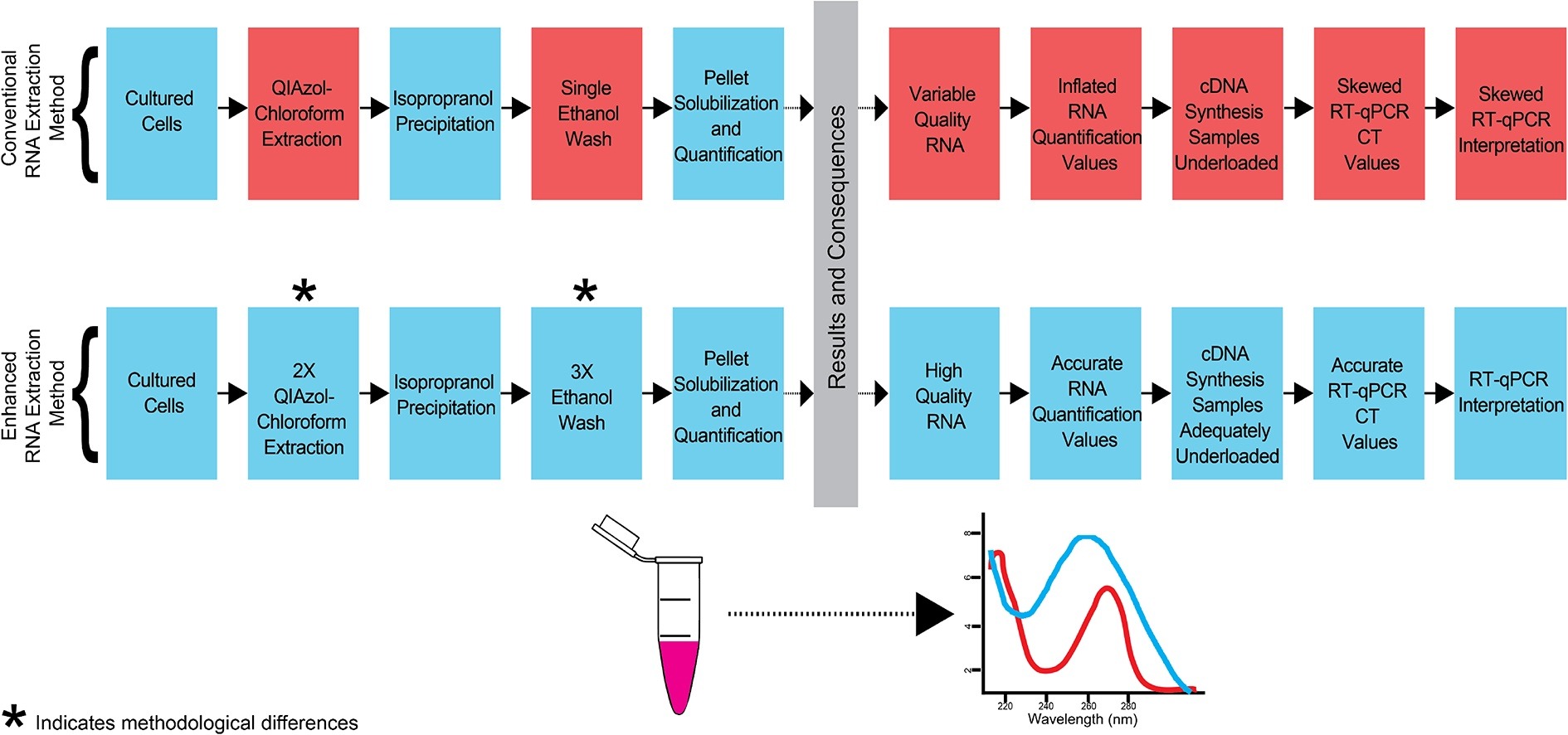
Graphical Abstract. A graphical representation of the differences between the conventional RNA extraction method and an enhanced RNA extraction method designed to reduce contaminant carryover into RNA preparations. Adapted from "Optimization of phenol-chloroform RNA extraction," by Toni LS, et al. (2018), MethodsX, 5, p. 599-608. Click to see expanded image.

RNA isolation protocol using the phenol/chloroform extraction method
Below is a total RNA isolation protocol using a phenol/chloroform extraction workflow. This protocol is intended for liquid samples, such as virus preparations, and is based on a TRIzol LS-type workflow. Conditions may need to be adjusted for different sample types, sample volumes, RNA input levels, or downstream applications.
For optimal results, special attention should be paid to the removal of RNase contamination. Disposable materials, such as microfuge tubes and pipette tips, should be sterile and RNase-free. Work surfaces and non-disposable tools and instruments, such as micropipettors and centrifuges, should be treated with an appropriate cleaning agent suitable for eliminating RNases.
Safety note: Phenol and chloroform are hazardous chemicals. Perform phenol/chloroform steps in a chemical fume hood using appropriate PPE and follow institutional procedures for chemical handling and waste disposal.
- Sample homogenization and phase separation
- In a microfuge tube, add 3 volumes of TRIzol LS Reagent or an equivalent acid guanidinium thiocyanate-phenol reagent suitable for liquid samples to 1 volume of liquid sample (e.g., 750 µL of TRIzol LS Reagent + 250 µL of virus preparation).
- Mix well by pipetting up and down several times.
- Incubate for 5 min at room temperature.
- Add 200 µL of chloroform per 750 µL of TRIzol LS Reagent or equivalent reagent used.
- Vortex at the maximum setting for 15 sec.
- Incubate for 3 min at room temperature.
- Centrifuge at 12000 x g for 15 min at 4°C.
At this step, the upper aqueous phase contains total RNA, while DNA is enriched at the interphase and proteins partition mainly into the lower organic phase. - Carefully transfer the upper aqueous phase to a new tube without disturbing the interphase.
- For an additional cleanup step, add fresh chloroform at 200 µL per 750 µL of original TRIzol LS Reagent or equivalent reagent used.
- Vortex for 15 sec, incubate for 3 min at room temperature, and centrifuge at 12000 x g for 15 min at 4°C.
- Carefully transfer the upper aqueous phase to a new tube without disturbing the interphase.
- RNA precipitation
- Transfer the upper aqueous phase to a new tube containing isopropanol (500 µL of isopropanol per 750 µL of original TRIzol LS Reagent or equivalent reagent used).
- Mix by inverting 10-20 times.
- Incubate for 10 min at room temperature.
- Centrifuge at 12000 x g for 10 min at 4°C.
At this step, the precipitated RNA should form a pellet. The pellet size and level of visibility will depend on the RNA concentration. - Remove the supernatant carefully without disturbing the RNA pellet.
- RNA washes
- To the pellet, add 1 mL of 75% ethanol per 750 µL of original TRIzol LS Reagent or equivalent reagent used.
- Centrifuge at 7500 x g for 5 min at 4°C.
- Remove the supernatant carefully without disturbing the pellet.
- Repeat steps 3a-c two additional times if improved removal of residual phenol, salts, or other contaminants is desired.
- Pulse spin at room temperature.
- Carefully remove residual supernatant with a micropipettor without disturbing the pellet.
- Air-dry the pellet briefly at room temperature until residual ethanol has evaporated, typically 3-5 min. Do not over-dry the pellet, as this can make the RNA more difficult to solubilize.
- RNA solubilization
- Resuspend the pellet in 20-50 µL of RNase-free water by pipetting up and down.
- Incubate at 55-60°C for 10-15 min, or until the RNA pellet is fully dissolved.
- Vortex for 5-10 sec, pulse spin, and place on ice.
- Measure the extracted total RNA concentration and purity. RNA integrity may also be assessed depending on the downstream application.
The RNA is now ready for downstream applications or storage at -80°C for later use.
Reference
Toni LS, et al. (2018). Optimization of phenol-chloroform RNA extraction. MethodsX.
**This suggested protocol should be optimized by the user based on sample type, input amount, RNA yield, purity requirements, and downstream application.**
For more info, visit our Methods of Virus Purification page.
Phenol/chloroform-based extraction can be effective for isolating RNA from compatible sample types, but it requires careful handling, phase separation, precipitation, washing, and optimization. For a more convenient solution for RNA isolation, complete with required buffers and reagents, you may also review our viral and total RNA extraction kit options:




