 Our single B-cell derived recombinant rabbit monoclonal antibodies have vastly improved reliability and reproducibility.




Cell-fate studies often ask a deceptively simple question: why does a gene stay off? In pluripotent stem cells, progenitors, and differentiating tissues, many lineage-specifying genes are not permanently inactive. They are held in a controlled repressed state, protected from inappropriate activation, and released only when cells receive the right developmental cues. Polycomb group proteins are central to this form of repression.
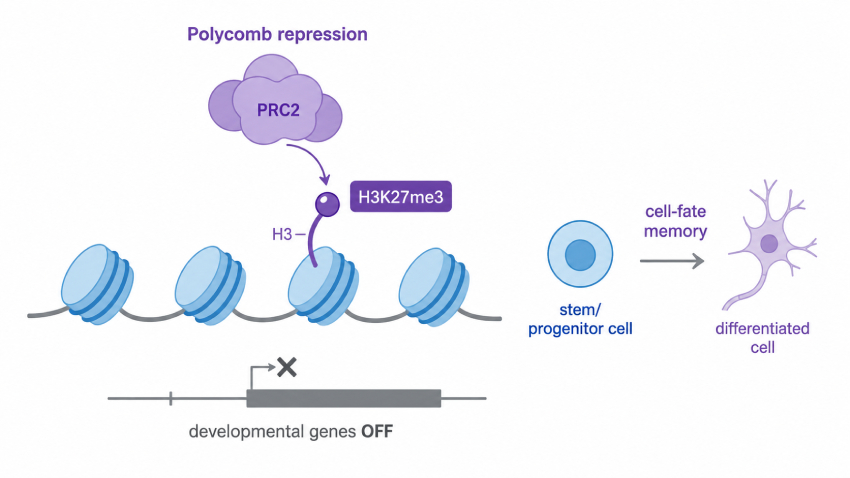
For researchers, the challenge is not only to detect H3K27me3, the histone mark most closely associated with Polycomb Repressive Complex 2 (PRC2), but also to interpret what the mark means in a biological system. A global increase in H3K27me3 can suggest broad chromatin repression, but it does not identify the affected genes. A strong H3K27me3 ChIP signal at a promoter can point to Polycomb enrichment, but it does not by itself prove transcriptional silencing. A loss of H3K27me3 after differentiation, inhibitor treatment, or genetic perturbation can reflect a lineage transition, an altered writer complex, a change in chromatin accessibility, or differences in sample preparation.
The practical goal is to connect H3K27me3 biology with cell identity, then choose assays that separate global chromatin shifts from gene-specific Polycomb regulation. A well-designed workflow often combines total histone preparation, global or multiplex histone mark profiling, antibody-based H3K27me3 detection, and chromatin enrichment analysis at specific genomic regions. That layered approach helps researchers interpret repression in the context of development, stem cell identity, and lineage memory.
A practical Polycomb study design
A well-balanced study of Polycomb repression and cell-fate memory might use the following structure:
- Define the biological transition. Examples include pluripotent stem cell differentiation, lineage reprogramming, organoid maturation, cancer cell state switching, or drug-induced chromatin remodeling.
- Prepare matched sample fractions. Collect material for histone modification analysis, RNA expression analysis, protein detection, and chromatin profiling. Consistent sample handling is critical when comparing developmental time points, treated and untreated cells, or heterogeneous populations.
- Screen global or multiplex histone modification patterns. Determine whether H3K27me3 changes occur in the context of broader chromatin remodeling. Include total histone normalization, biological replicates, and appropriate untreated or baseline controls.
- Select candidate genes or regulatory regions. Prioritize targets based on developmental relevance, RNA expression data, known Polycomb occupancy, or observed changes in cell identity markers.
- Profile H3K27me3 enrichment at specific regions or genome wide. ChIP-qPCR can be useful for targeted validation, while ChIP-seq, CUT&RUN, CUT&Tag, and CUT&LUNCH can provide broader chromatin maps of promoters, enhancers, and Polycomb domains.
- Add supporting histone mark analysis. Include additional marks when the hypothesis involves broader chromatin context, such as changes in H3K27ac, H3K4me3, H3K9me3, H4 acetylation, or H4K20 methylation.
- Integrate chromatin, transcriptional, and phenotypic readouts. H3K27me3 is most informative when interpreted together with RNA expression, lineage marker status, differentiation behavior, and cell phenotype.
What is Polycomb repression?
Polycomb repression refers to chromatin-mediated gene silencing controlled mainly by two families of multiprotein complexes: PRC2 and PRC1. PRC2 contains the catalytic subunits EZH1 or EZH2, which methylate histone H3 lysine 27 to generate H3K27me1, H3K27me2, and H3K27me3. H3K27me3 is concentrated at many Polycomb-regulated developmental genes and is commonly associated with facultative heterochromatin, a repressed chromatin state that can differ by cell type.
PRC1 complexes add another layer. Canonical PRC1 can recognize H3K27me3 through chromobox proteins and can compact chromatin, while non-canonical PRC1 variants can deposit H2AK119ub and participate in recruitment and silencing independently of canonical H3K27me3 recognition. This means Polycomb repression should not be reduced to one mark or one complex. Current reviews emphasize that mammalian Polycomb biology involves multiple PRC1 and PRC2 variants with context-specific recruitment, catalytic behavior, and developmental functions [1-3].
A useful working model is that PRC2 helps establish and propagate H3K27 methylation at target regions, while PRC1 contributes to chromatin compaction, H2AK119ub deposition, and stabilization of repressed chromatin domains. The relationship is not strictly linear in all systems. Some loci depend strongly on PRC2-mediated H3K27me3, while others show partial repression even when H3K27me3 is reduced, indicating that Polycomb repression is modular and locus dependent [4,5].
H3K27me3 as a memory mark
Cell-fate memory is the capacity of a cell to preserve transcriptional identity through DNA replication, mitosis, and changing signaling environments. H3K27me3 contributes to this memory because it can remain associated with repressed developmental loci and help guide restoration of repressive chromatin after cell division. Classic and current models propose that parental nucleosomes carrying H3K27me3 can help recruit PRC2 to newly deposited histones, reinforcing local propagation of the mark.
This does not mean H3K27me3 is a static label. During development, H3K27me3 domains can contract, expand, or shift. Genes required in one lineage may lose Polycomb repression as they become activated, while genes associated with alternative lineages may gain or retain H3K27me3. In stem cells, many developmental regulators are maintained in a poised or repressed condition, often within chromatin environments that combine active and repressive features, such as H3K4me3 and H3K27me3 at bivalent promoters. This bivalent architecture helps explain why stem cells can maintain developmental potential while preventing premature lineage gene activation [6].
Recent work also connects H3K27me3 spreading to higher-order chromatin organization. A 2026 Nature Genetics study reported that H3K27me3 spreading organizes canonical PRC1-associated chromatin interactions and affects gene silencing relevant to cell fate specification [7]. This supports a broader view: H3K27me3 is not only a local promoter mark. It can participate in domain-level repression, chromatin folding, and the maintenance of transcriptional programs.
Polycomb repression in stem cells and development
Polycomb biology is especially important in stem cells because stem cells must preserve self-renewal while retaining the capacity to differentiate. In embryonic stem cells and induced pluripotent stem cells, PRC2 and PRC1 help restrain lineage-inappropriate transcriptional programs. When cells differentiate, selected Polycomb targets are released, while alternative lineage programs may remain repressed.
Two 2022 Nature Cell Biology studies are particularly useful for thinking about early human development. Kumar et al. reported that PRC2 shields naive human pluripotent cells from trophectoderm differentiation, supporting the idea that Polycomb repression helps protect lineage integrity. In parallel, an integrated multi-omics study found enrichment of PRC2-associated H3K27me3 in naive pluripotent stem cells at lineage-determining genes, including trophoblast regulators, and showed that PRC2 inhibition promoted trophoblast-fate induction in human blastoid models [8,9].
These studies illustrate a practical point for experimental design. If a perturbation causes cells to drift toward an unintended lineage, the question is not only whether H3K27me3 changes globally. Researchers also need to know whether H3K27me3 is lost at key lineage regulators, whether H3K27ac or H3K4me3 increases at the same loci, and whether the transcriptional program follows the chromatin change.
H3K27me3 versus H3K27ac: a key interpretive contrast
H3K27me3 and H3K27ac modify the same lysine residue on histone H3 but usually correspond to opposite regulatory states. H3K27me3 is associated with Polycomb repression. H3K27ac is associated with active promoters and enhancers. Because the same lysine cannot be both trimethylated and acetylated on the same histone molecule, the balance between H3K27 methylation and acetylation is an important readout of regulatory switching.
This contrast is especially relevant during differentiation. A developmental enhancer may gain H3K27ac as it becomes active. A lineage-inappropriate gene may retain H3K27me3. A poised promoter may carry H3K4me3 together with H3K27me3, then resolve toward activation or stable repression. Therefore, H3K27me3 should usually be interpreted alongside activating marks and total histone normalization.
The EpiQuik Histone H3 Modification Multiplex Assay Kit (P-3100) supports this type of screening by measuring multiple H3 modifications in the same sample set, including H3K27me3, H3K27me1, H3K27me2, H3K4 methylation states, H3K9 methylation states, H3K36 methylation states, H3K79 methylation states, selected acetylation marks, and total H3. In a cell-fate study, this kind of multiplex view can help distinguish a Polycomb-centered change from a broader remodeling of the histone modification landscape.
Experimental strategy: start broad, then map loci
A strong Polycomb study usually combines several levels of measurement.
First, global or multiplex histone mark analysis can identify whether a treatment, differentiation time point, knockdown, inhibitor, or culture condition changes the overall chromatin state. With P-3100, researchers can compare paired samples, such as control versus treated cells or undifferentiated versus differentiated cells, and evaluate H3K27me3 in the context of other H3 marks. This is useful before investing in sequencing-scale experiments, especially when sample number is high or when the likely direction of change is unknown.
Second, locus-specific chromatin profiling is needed to determine where H3K27me3 changes occur. Antibody-based methods such as ChIP-qPCR, ChIP-seq, CUT&RUN, CUT&Tag, and CUT&LUNCH remain central for mapping H3K27me3 enrichment at developmental genes, promoters, Polycomb domains, and regulatory elements. EpigenTek’s Histone H3K27me3 Polyclonal Antibody (A-4039) fits this stage of the workflow for applications with assay-specific optimization required.
Third, the histone extraction step matters. Global histone modification assays depend on clean, compatible histone preparations. The EpiQuik Total Histone Extraction Kit (OP-0006) provides a streamlined way to prepare total histones from mammalian cells and tissues for downstream histone modification analysis. Consistency at this stage is especially important when comparing developmental time points, primary samples, or treated and untreated populations.
Finally, supporting histone context can improve interpretation. The EpiQuik Histone H4 Modification Multiplex Assay Kit (P-3102) measures multiple H4 modifications, including H4 acetylation marks and H4K20 methylation states. H4K16ac, H4K20me3, and related H4 marks do not replace H3K27me3 analysis, but they can help researchers determine whether a Polycomb-associated change is part of a broader chromatin compaction, heterochromatin, or acetylation shift.
Choosing between ChIP-seq, CUT&RUN, CUT&Tag, and CUT&LUNCH for H3K27me3
H3K27me3 domains can be broad, and that makes method choice important. Conventional ChIP-seq remains widely used and has a deep literature base. CUT&RUN and CUT&Tag can offer lower background, lower input requirements, and sharper localization in many settings, but they are not always interchangeable with ChIP-seq. CUT&LUNCH can be discussed in the same decision framework as another antibody-based chromatin profiling option for mapping histone marks and chromatin-associated proteins, particularly when researchers are evaluating alternatives to conventional ChIP workflows.
A recent comparative analysis of ChIP-seq, CUT&RUN, and CUT&Tag for Polycomb chromatin profiling reported that CUT&RUN preferentially captured broad H3K27me3 domains, while CUT&Tag produced sharper and more localized enrichment for H3K27me3 and EZH2 [10]. Another benchmarking study comparing CUT&Tag to ENCODE ChIP-seq profiles in K562 cells reported an average recall of 54% known ENCODE peaks for H3K27ac and H3K27me3, highlighting how assay type, peak calling, and analysis parameters influence apparent recovery of chromatin features [11]. CUT&LUNCH should be evaluated with the same practical criteria: antibody compatibility, input amount, signal-to-background performance, peak shape, target type, sequencing plan, and downstream analysis workflow.
The practical takeaway is simple: choose the assay based on the biological question. For broad Polycomb domains, domain-level normalization and broad peak calling are important. For promoter-level comparisons or low-input studies, CUT&RUN, CUT&Tag, or CUT&LUNCH may be attractive, but antibody validation and analysis settings become especially important. For confirmatory work at known loci, ChIP-qPCR remains useful because it is targeted, interpretable, and easier to scale across conditions.
Common interpretation pitfalls
The most common mistake is treating global H3K27me3 as equivalent to locus-specific repression. A global assay can show whether total H3K27me3 changes across the sample, but it cannot identify which promoters or enhancers are affected. Conversely, sequencing can identify enriched regions, but enrichment alone does not prove that a gene is transcriptionally silent. RNA analysis, protein expression, or functional differentiation markers are usually needed.
A second mistake is ignoring cell population heterogeneity. In mixed cultures, bulk H3K27me3 signals can reflect a shift in cell composition rather than a uniform chromatin change in every cell. Single-cell chromatin technologies are increasingly useful here. For example, single-cell CUT&Tag studies have used H3K27me3 to distinguish cell types and generate cell-type-specific Polycomb landscapes from heterogeneous tissues [12].
A third mistake is assuming that H3K27me3 loss always equals activation. Some genes may require additional transcription factors, enhancer activation, chromatin opening, or loss of DNA methylation constraints before transcription occurs. Polycomb removal can create competence, but transcriptional activation depends on the broader regulatory environment.
A fourth mistake is failing to normalize to total histone content. Changes in histone extraction yield, cell-cycle state, cell death, or chromatin content can affect apparent signal. For global assays, total H3 normalization and careful sample input control are essential.
Product selector for Polycomb and H3K27me3 workflows
| Research need | Relevant product | Best fit in the workflow |
|---|---|---|
| Prepare histones from mammalian cells or tissues for downstream histone modification analysis | EpiQuik Total Histone Extraction Kit (OP-0006) | Use at the start of global or multiplex histone modification workflows to support consistent histone extraction. |
| Screen H3K27me3 together with other major H3 marks | EpiQuik Histone H3 Modification Multiplex Assay Kit (P-3100) | Use for paired comparisons such as control versus treated, undifferentiated versus differentiated, or normal versus disease-model samples. |
| Map or validate H3K27me3 enrichment at specific loci or in chromatin profiling workflows | Histone H3K27me3 Polyclonal Antibody (A-4039) | Use for antibody-based detection workflows with assay-specific optimization. |
| Add H4 chromatin context to H3K27me3 findings | EpiQuik Histone H4 Modification Multiplex Assay Kit (P-3102) | Use when repression may involve broader chromatin architecture, H4 acetylation, or H4K20 methylation changes. |
References
- Blackledge NP, Klose RJ. The molecular principles of gene regulation by Polycomb repressive complexes. Nat Rev Mol Cell Biol. 2021;22(12):815-833. doi:10.1038/s41580-021-00398-y. View article
- Piunti A, Shilatifard A. The roles of Polycomb repressive complexes in mammalian development and cancer. Nat Rev Mol Cell Biol. 2021;22(5):326-345. doi:10.1038/s41580-021-00341-1. View article
- Laugesen A, Højfeldt JW, Helin K. Molecular Mechanisms Directing PRC2 Recruitment and H3K27 Methylation. Mol Cell. 2019;74(1):8-18. doi:10.1016/j.molcel.2019.03.011. View article
- Beltran M, Yates CM, Skalska L, et al. The interaction of PRC2 with RNA or chromatin is mutually antagonistic. Genome Res. 2016;26(7):896-907. doi:10.1101/gr.197632.115. View article
- Jambhekar A, Dhall A, Shi Y. Roles and regulation of histone methylation in animal development. Nat Rev Mol Cell Biol. 2019;20(10):625-641. doi:10.1038/s41580-019-0151-1. View article
- Brand M, Nakka K, Zhu J, Dilworth FJ. Polycomb/Trithorax Antagonism: Cellular Memory in Stem Cell Fate and Function. Cell Stem Cell. 2019;24(4):518-533. doi:10.1016/j.stem.2019.03.005. View article
- Krug B, Hu B, Chen H, et al. H3K27me3 spreading organizes canonical PRC1 chromatin architecture to regulate developmental programs. Nat Genet. 2026;58(6):1368-1382. doi:10.1038/s41588-026-02586-y. View article
- Kumar B, Navarro C, Winblad N, et al. Polycomb repressive complex 2 shields naïve human pluripotent cells from trophectoderm differentiation. Nat Cell Biol. 2022;24(6):845-857. doi:10.1038/s41556-022-00916-w. View article
- Zijlmans DW, Talon I, Verhelst S, et al. Integrated multi-omics reveal polycomb repressive complex 2 restricts human trophoblast induction. Nat Cell Biol. 2022;24(6):858-871. doi:10.1038/s41556-022-00932-w. View article
- Oh Y, Kim H, Lee S, et al. Comparative analyses of ChIP-seq, CUT&RUN and CUT&Tag for Polycomb chromatin profiling. BMB Rep. 2026;59(4):242-252. doi:10.5483/BMBRep.2025-0247. View article
- Abbasova L, Urbanaviciute P, Hu D, et al. CUT&Tag recovers up to half of ENCODE ChIP-seq histone acetylation peaks. Nat Commun. 2025;16(1):2993. Published 2025 Mar 27. doi:10.1038/s41467-025-58137-2. View article
- Bartosovic M, Kabbe M, Castelo-Branco G. Single-cell CUT&Tag profiles histone modifications and transcription factors in complex tissues. Nat Biotechnol. 2021;39(7):825-835. doi:10.1038/s41587-021-00869-9. View article