




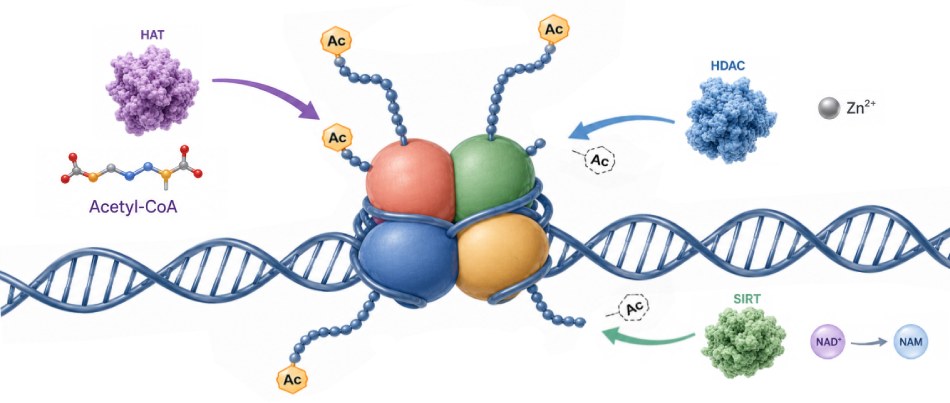
A change in histone acetylation rarely identifies its own mechanism. Increased acetylation can arise from stronger lysine acetyltransferase activity, weaker deacetylase activity, altered acetyl-CoA or NAD+ availability, redistribution of enzyme complexes, changes in histone turnover, or combinations of these processes. The same acetylation endpoint can therefore emerge from biologically different regulatory states.
That ambiguity becomes especially important in experiments involving differentiation, cellular stress, metabolism, inflammation, aging, or environmental perturbation. Histone acetylation may change quickly, but protein abundance alone cannot establish whether an acetyltransferase or deacetylase has become more or less catalytically active. Conversely, an enzyme activity assay measures catalytic capacity without revealing where that activity acts across the genome.
A more informative experimental design separates three related measurements: enzyme activity, global histone modification state, and locus-specific chromatin enrichment. HAT, HDAC, and SIRT activity assays address the first layer. Histone acetylation assays characterize the second. ChIP or related chromatin profiling approaches are needed when the biological question concerns individual promoters, enhancers, or other genomic regions.
Acetylation is a dynamic chromatin reaction, not a static mark
Histone acetylation is produced by lysine acetyltransferases, traditionally called histone acetyltransferases or HATs, that transfer an acetyl group from acetyl-CoA to lysine residues. Deacetylases reverse that chemistry. The balance is dynamic enough that an apparently stable acetylation level may represent substantial opposing catalytic flux rather than low enzyme activity.
The writer side is also more complex than a simple relationship between one HAT and one histone site. GCN5 and the closely related PCAF, for example, function within large transcriptional assemblies including SAGA and ATAC. Their effects depend on complex composition, recruitment, substrate recognition, and biological state [1]. p300 and CBP combine acetyltransferase activity with domains that recognize chromatin features, giving these enzymes both catalytic and chromatin-interaction functions.
Structural work on p300/CBP illustrates how strongly chromatin context can shape acetylation. Kikuchi and colleagues showed that p300/CBP can recognize acetylated histone H4 through its bromodomain while positioning its catalytic machinery toward additional histone tails in the same nucleosome. Their cryo-EM and biochemical analysis identified H2B N-terminal acetylation as a major downstream event and linked that acetylation to H2A-H2B dissociation from the nucleosome [2]. Acetylation can therefore participate in local propagation and nucleosome destabilization rather than functioning as a simple binary marker of active transcription.
These mechanisms also explain why histone acetylation should not be treated as synonymous with chromatin accessibility. Acetylation can reduce favorable electrostatic interactions between histones and DNA and can recruit acetyl-lysine reader proteins, but nucleosome positioning, ATP-dependent remodeling, transcription factor occupancy, histone variants, and higher-order organization also determine accessibility.
HAT activity identifies the writer side of the balance
A rise in acetylated histone H3 does not establish that HAT activity increased. Reduced deacetylation can produce the same endpoint. Direct assessment of acetyltransferase activity becomes useful when the experiment asks whether the catalytic writer machinery itself has changed.
Modern HAT assays use several detection strategies, including radiometric transfer assays, coupled enzyme reactions, antibody-based detection, fluorescence, and luminescence. Recent assay development continues to emphasize direct or closely coupled measurements of catalytic turnover. Swain and Zheng, for example, reported a microplate bioluminescent system for HAT activity that measured p300 catalytic activity and kinetic parameters and achieved a Z’ factor of 0.79 in their assay configuration [3]. That performance metric reflects the continuing effort to distinguish catalytic activity from downstream acetylation abundance.
For experiments using nuclear extracts or purified HAT enzymes, the EpiQuik HAT Activity/Inhibition Assay Kit (P-4003) provides a direct histone-substrate readout of total HAT activity. Active HATs acetylate a captured histone substrate, and the acetylated product is quantified through an antibody-based colorimetric reaction. This format fits studies where total HAT catalytic output is the experimental variable rather than the abundance of a particular HAT protein.
Total HAT activity still cannot identify which acetyltransferase produced the signal. Isoform-specific mechanistic conclusions require additional perturbation, purification, immunoprecipitation, genetic manipulation, or other enzyme-specific strategies.
Classical HDACs depend on complexes as well as catalytic domains
The mammalian deacetylase family contains 18 commonly recognized members. Eleven are the zinc-dependent HDAC1 through HDAC11 enzymes, while seven are NAD+-dependent sirtuins [4]. Grouping all 18 under the term HDAC can obscure a substantial biochemical divide between these two systems.
Classical HDACs also do not generally operate as freely interchangeable enzymes. HDAC1, HDAC2, and HDAC3 participate in large corepressor assemblies such as Sin3, NuRD, CoREST, and NCoR/SMRT. Complex formation can alter catalytic activity, substrate recognition, recruitment, and genomic targeting [4]. Stable HDAC protein levels therefore do not guarantee stable deacetylase output.
Chromatin substrate architecture adds another layer. Moreno-Yruela and Fierz reviewed evidence showing that HDAC behavior measured with short peptide substrates can differ substantially from behavior toward nucleosomes. Reconstituted chromatin systems reveal recognition mechanisms that are difficult to infer from peptide assays alone [5]. Enzyme activity measured in an extract is consequently best interpreted as functional catalytic capacity under the assay conditions, not as a direct map of deacetylation at individual chromatin sites.
The Epigenase HDAC Activity/Inhibition Direct Assay Kit (P-4034) measures total HDAC activity from nuclear extracts or purified HDAC1-11 enzymes by detecting HDAC-converted deacetylated histone substrate. It is suited to experiments comparing deacetylase activity across biological conditions before asking which HDAC complex or genomic region accounts for the difference.
Sirtuins connect deacetylation with cellular metabolic state
Sirtuins require NAD+ for catalysis, separating them mechanistically from zinc-dependent HDACs. Mammalian SIRT1 through SIRT7 also differ in localization and substrate range. Nuclear members can directly influence chromatin, while other family members have major cytoplasmic or mitochondrial functions. Sirtuins act on histone and non-histone substrates and can exhibit deacetylase, broader deacylase, or ADP-ribosyltransferase activities depending on the enzyme [6].
The dependence on NAD+ places sirtuin activity near the intersection of metabolism and epigenetic regulation. Changes in cellular redox state, NAD+ metabolism, compartmentalization, stress response, or nutrient availability can alter the biochemical environment in which sirtuins operate even without a proportional change in SIRT protein expression.
This makes classical HDAC activity and SIRT activity worth separating experimentally. Zessin and colleagues describe distinct biochemical assay approaches for zinc-dependent HDACs and NAD+-dependent sirtuins, reflecting their different catalytic requirements [7]. Treating the two groups as one deacetylase variable can obscure which arm of the acetylation system responded to a perturbation.
The Epigenase Universal SIRT Activity/Inhibition Assay Kit (P-4036) measures total SIRT activity from appropriate cellular fractions or purified SIRT enzymes and supplies NAD+ as the required cofactor. The assay supports SIRT1-SIRT7 activity analysis while preserving the biochemical separation between sirtuins and classical HDACs.
Enzyme activity and histone acetylation answer different questions
Catalytic activity becomes considerably more informative when paired with a downstream histone readout. Four common result patterns illustrate the logic:
| Enzyme result | Histone acetylation result | Interpretation to investigate |
|---|---|---|
| HAT activity increases | Acetylation increases | Increased writer activity is consistent with the endpoint, although reduced deacetylation may contribute |
| HDAC or SIRT activity decreases | Acetylation increases | Reduced eraser activity is a plausible driver |
| Enzyme activity changes | Acetylation is stable | Opposing enzyme activity, substrate limitation, compensatory regulation, or locus-restricted effects may mask a global shift |
| Acetylation changes | Measured enzyme activity is stable | Recruitment, cofactors, another enzyme family, histone turnover, or chromatin context may account for the endpoint |
Global histone acetylation is particularly useful for establishing whether an enzyme-level perturbation propagates to the histone pool. The EpiQuik Total Histone H3 Acetylation Detection Fast Kit (P-4030) measures total acetylated histone H3 and can serve as a downstream readout alongside HAT, HDAC, or SIRT activity measurements. It does not identify the genomic loci carrying those acetylated histones.
Experiments involving broader chromatin remodeling may require more than one acetylation endpoint. The EpiQuik Histone H3 Modification Multiplex Assay Kit (P-3100) measures 21 H3 modification patterns, including H3K9ac, H3K14ac, H3K18ac, and H3K56ac alongside multiple methylation and phosphorylation states. Such profiling can reveal whether an acetylation response occurs in isolation or accompanies a wider change in histone modification state.
Neither global assay substitutes for ChIP or sequencing-based chromatin profiling. A global increase in H3 acetylation cannot establish that a specific enhancer or promoter gained acetylation.
Product Selector for Acetylation and Deacetylation Workflows
| Product | Primary measurement | Best fit in the experimental design |
|---|---|---|
| EpiQuik HAT Activity/Inhibition Assay Kit (P-4003) | Total HAT catalytic activity | Testing the writer side of histone acetylation using nuclear extracts or HAT enzymes |
| Epigenase HDAC Activity/Inhibition Direct Assay Kit (P-4034) | Total classical HDAC activity | Comparing deacetylase activity across treatments, samples, or purified HDAC enzymes |
| Epigenase Universal SIRT Activity/Inhibition Assay Kit (P-4036) | Total NAD+-dependent SIRT activity | Separating sirtuin activity from zinc-dependent HDAC activity |
| EpiQuik Total Histone H3 Acetylation Detection Fast Kit (P-4030) | Global acetylated histone H3 | Determining whether enzyme-level changes are accompanied by a change in total H3 acetylation |
| EpiQuik Histone H3 Modification Multiplex Assay Kit (P-3100) | Multiple H3 modification states | Placing acetylation changes within a broader H3 modification profile |
Building a functional chromatin plasticity experiment
A strong study begins by defining which regulatory layer carries the hypothesis.
Catalytic regulation: Measure HAT, classical HDAC, or SIRT activity when the hypothesis concerns enzyme function. Comparing enzyme activity with protein abundance can reveal regulation that expression measurements alone miss.
Histone modification state: Add total or site-resolved histone acetylation measurements to determine whether altered catalytic activity is reflected in the histone pool.
Genomic localization: Use ChIP or another chromatin profiling method when the hypothesis concerns a defined promoter, enhancer, chromatin domain, or genome-wide distribution.
Causal perturbation: Genetic depletion, catalytic mutants, selective chemical probes, cofactor manipulation, or rescue experiments can help distinguish correlated activity changes from direct regulatory mechanisms.
The most useful datasets connect these levels without collapsing them into a single readout. An activity assay may reveal altered catalytic potential before a large global acetylation shift appears. A histone assay can show that the modification state changed while leaving the responsible enzyme unresolved. Genomic profiling can localize that change but may still require enzyme measurements to explain its biochemical origin.
References- Dent SYR. KAT tales: Functions of Gcn5 and PCAF lysine acetyltransferases in SAGA and ATAC. J Biol Chem. 2024;300(10):107744. doi:10.1016/j.jbc.2024.107744. View article
- Kikuchi M, Morita S, Wakamori M, et al. Epigenetic mechanisms to propagate histone acetylation by p300/CBP. Nat Commun. 2023;14(1):4103. Published 2023 Jul 17. doi:10.1038/s41467-023-39735-4. View article
- Swain ND, George Zheng Y. Design of a Bioluminescent Assay Platform for Quantitative Measurement of Histone Acetyltransferase Enzymatic Activity. Chembiochem. 2025;26(1):e202400692. doi:10.1002/cbic.202400692. View article
- Asmamaw MD, He A, Zhang LR, Liu HM, Gao Y. Histone deacetylase complexes: Structure, regulation and function. Biochim Biophys Acta Rev Cancer. 2024;1879(5):189150. doi:10.1016/j.bbcan.2024.189150. View article
- Moreno-Yruela C, Fierz B. Revealing chromatin-specific functions of histone deacylases. Biochem Soc Trans. 2024;52(1):353-365. doi:10.1042/BST20230693. View article
- Samoilova EM, Romanov SE, Chudakova DA, Laktionov PP. Role of sirtuins in epigenetic regulation and aging control. Vavilovskii Zhurnal Genet Selektsii. 2024;28(2):215-227. doi:10.18699/vjgb-24-26. View article
- Zessin M, Meleshin M, Sippl W, Schutkowski M. Continuous Histone Deacylase Activity Assays. Methods Mol Biol. 2023;2589:411-428. doi:10.1007/978-1-0716-2788-4_27. View article



