 Our single B-cell derived recombinant rabbit monoclonal antibodies have vastly improved reliability and reproducibility.



 Cart (0)


Cell-state plasticity is often discussed as a biological outcome: a cancer cell adopts a drug-tolerant phenotype, a stem-like cell begins lineage priming, an immune cell shifts from resting to activated, or a differentiated cell responds to stress. For researchers, the practical problem is more specific: how can a change in regulatory potential be detected before it becomes a stable transcriptional endpoint?
Enhancer activation is one of the most informative places to look. Enhancers integrate transcription factor binding, chromatin accessibility, histone modifications, coactivator recruitment, enhancer RNA production, and promoter communication. Among the chromatin marks used to study this process, histone H3 lysine 27 acetylation, or H3K27ac, is one of the most widely used indicators of active regulatory elements.
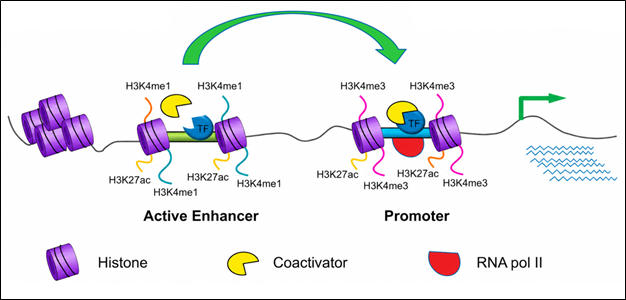
Active enhancers use marks such as H3K4me1 and H3K27ac and communicate with promoters through chromatin looping.
Image credit: Xia and Wei, Cells 2019.
The challenge is that H3K27ac can be measured at different biological resolutions. A global increase in H3K27ac can indicate a broad shift in acetylation state, but it does not identify which enhancers changed. H3K27ac ChIP-seq, CUT&RUN, or CUT&Tag (as well as the newer CUT&LUNCH method) can identify locus-specific enrichment, but these methods require careful antibody selection, sequencing design, and data analysis. Multiplex histone modification profiling adds another layer by helping researchers interpret H3K27ac in the context of H3K4 methylation, H3K27 methylation, and broader acetylation programs.
Because enhancer activation can be studied at multiple levels, product selection should follow the biological question rather than the other way around. A practical workflow often begins with consistent histone extraction, moves into global H3K27ac quantification, adds broader H3 and H4 modification context when needed, and then uses antibody-based chromatin mapping to identify the specific regulatory elements involved. EpigenTek supports this progression across histone preparation, global and multiplex histone modification assays, and H3K27ac antibody-based analysis, allowing researchers to move from screening to mechanistic follow-up without treating any single assay as the whole answer.
What H3K27ac Tells Researchers About Enhancer Activation
H3K27ac is an acetylation mark on lysine 27 of histone H3. It is enriched at active promoters and active enhancers and is commonly used to distinguish active enhancers from poised or primed enhancers when interpreted with other marks such as H3K4me1, H3K4me3, and H3K27me3.
A simplified enhancer-state framework is useful:
Primed or poised enhancers are often H3K4me1-positive but have low H3K27ac.
Active enhancers typically gain H3K27ac, recruit coactivators such as p300/CBP, and may produce enhancer RNAs.
Repressed or Polycomb-associated regulatory regions may be enriched for H3K27me3.
Promoters are often distinguished from enhancers by stronger H3K4me3 enrichment.
This matters for plasticity because many cell-state transitions begin through enhancer remodeling before the full transcriptional program is established. For example, a lineage-determining transcription factor may bind closed or partially accessible chromatin, recruit chromatin modifiers, and increase H3K27ac at enhancers controlling future identity genes. In other settings, cells may lose H3K27ac at one set of regulatory elements while gaining it at another, reflecting enhancer decommissioning and enhancer activation.
The classic study by Creyghton and colleagues helped establish H3K27ac as a mark that separates active from poised enhancers and predicts developmental state [1]. Later work expanded this view by showing that enhancer landscapes are highly cell type-specific and that combinations of histone marks, accessibility, and transcription factor occupancy can define regulatory programs across tissues and differentiation states.
The Roadmap Epigenomics Consortium provided a large-scale example of why this matters. Its integrative analysis of 111 reference human epigenomes included thousands of histone modification, accessibility, methylation, and RNA datasets and showed that enhancer and promoter signatures occupy a measurable fraction of each epigenome [2]. The study reported that approximately 5% of each reference epigenome showed enhancer and promoter signatures, emphasizing how much cell identity information resides outside coding genes [2].
Why Cell-State Plasticity Is an Enhancer Problem
Cell-state plasticity depends on regulatory flexibility. A cell that can change state must have some way to access alternative gene expression programs. Enhancers provide that regulatory architecture because they are modular, cell type-specific, signal-responsive, and often located far from the genes they regulate.
In differentiation, enhancers help establish lineage identity. In immune activation, enhancers respond to cytokines, antigen receptor signaling, and inflammatory cues. In stem cell systems, enhancer priming can precede lineage commitment. In cancer research, enhancer rewiring is frequently studied in relation to transcriptional heterogeneity, therapy persistence, epithelial-to-mesenchymal transition, and oncogene-associated transcriptional programs.
Super-enhancers represent an intensified version of this concept. These are large clusters of enhancer elements with high enrichment of Mediator, BRD4, master transcription factors, and often H3K27ac. Early super-enhancer studies identified hundreds of such domains in embryonic stem cells, including regions associated with core pluripotency genes such as Oct4, Sox2, and Nanog [3]. The practical takeaway is that strong H3K27ac domains often highlight regulatory nodes that are disproportionately connected to cell identity [3,4].
However, enhancer strength should not be interpreted too narrowly. A high H3K27ac signal may reflect enhancer activation, promoter-proximal acetylation, high local nucleosome density, cell mixture effects, or a subpopulation shift. Cell-state plasticity studies should therefore ask three separate questions:
Is global H3K27ac changing?
Which genomic regions are gaining or losing H3K27ac?
Do those regions connect to transcriptional, phenotypic, or functional changes?
Each question requires a different assay strategy.
Measuring Global H3K27ac: When a Broad Acetylation Readout Is the Right First Step
Global H3K27ac quantification is useful when researchers need to screen conditions, compare time points, evaluate chromatin-wide acetylation shifts, or prioritize samples before sequencing.
Examples include:
Comparing untreated and stimulated cells.
Measuring time-dependent acetylation after differentiation induction.
Screening inhibitor or activator conditions that may affect HAT or HDAC activity.
Comparing bulk H3K27ac levels across cell populations before locus-specific analysis.
Normalizing expectations before ChIP-seq, CUT&RUN, CUT&Tag, or CUT&LUNCH.
The EpiQuik Global Acetyl Histone H3K27 Quantification Kit (P-4059) fits this role as a global H3K27ac quantification assay, while the EpiQuik Total Histone Extraction Kit (OP-0006) supports upstream histone preparation for downstream histone modification analysis.
This distinction is important. A global H3K27ac assay does not identify enhancer coordinates, target genes, or super-enhancers. It provides a quantitative sample-level readout that can guide whether deeper mapping is warranted. In a plasticity workflow, this kind of assay can help determine whether a treatment or transition causes a broad gain, loss, or stability of H3K27ac before sequencing.
Multiplex Histone Profiling: Putting H3K27ac Into Chromatin Context
H3K27ac should rarely be interpreted alone. Enhancer state depends on the surrounding chromatin environment. For example, an increase in H3K27ac at a regulatory region has a different interpretation if it occurs with H3K4me1 enrichment, H3K27me3 depletion, promoter-associated H3K4me3, or broad changes in H3 acetylation.
When H3K27ac changes need more chromatin context, multiplex histone modification profiling can help determine whether the shift is isolated or part of a broader remodeling program. The EpiQuik Histone H3 Modification Multiplex Assay Kit (P-3100) is most relevant when the question centers on H3 mark context, including active, repressive, and transcription-associated H3 modifications. P-3102 adds value when H4 acetylation or H4 methylation may help interpret chromatin compaction, accessibility, or broader acetylation balance.
A useful decision rule is this: use a focused H3K27ac assay when the question is "Did global H3K27ac change?" Add multiplex H3 and H4 profiling when the question is "What chromatin state is changing with it?"
Locus-Specific Mapping: When Researchers Need to Know Which Enhancers Changed
Global assays are efficient, but enhancer biology is genomic. Two samples can have similar total H3K27ac levels while redistributing acetylation across different enhancer sets. That redistribution may be the most important feature of cell-state plasticity.
Locus-specific mapping is required when researchers need to identify:
Enhancers that gain H3K27ac during activation or differentiation.
Enhancers that lose H3K27ac during repression or lineage exit.
Super-enhancer-like domains with unusually strong H3K27ac signal.
Candidate regulatory regions linked to genes of interest.
Changes in enhancer usage across cell subpopulations or time points.
H3K27ac ChIP-seq remains a common approach for genome-wide enhancer mapping. CUT&RUN and CUT&Tag are also widely used for chromatin profiling because they can offer lower background and lower input requirements compared with conventional ChIP-seq, depending on target, antibody, sample type, and protocol [5,6]. Researchers may also consider newer antibody-directed workflows, such as EpigenTek's CUT&LUNCH, particularly when reducing accessibility-associated background and non-specific DNA recovery at the assay level is a priority for improving target-specific enrichment. In the original CUT&Tag paper, Kaya-Okur and colleagues described an antibody-tethered Tn5 strategy that generates high-resolution libraries with low background and can be completed in one day [6]. The study also reported strong profiling efficiency at lower sequencing depth in comparative histone modification experiments [6].
For H3K27ac mapping by ChIP or ChIP-seq, Histone H3K27ac Polyclonal Antibody (A-4708) provides the direct mark-specific antibody option. Antibody choice is especially consequential for enhancer work because false enrichment, poor specificity, or lot-to-lot variability can alter peak calls and downstream enhancer ranking. Researchers should also validate antibody performance under the selected platform and sample conditions before assigning biological meaning to enhancer gains or losses.
Designing an H3K27ac Plasticity Experiment
A strong enhancer activation study should be organized around a staged question set.
1. Define the state transition
Start with a clear transition: resting to activated, stem-like to differentiated, epithelial-like to mesenchymal-like, untreated to treated, early to late time point, or responder to non-responder model. Include biological replicates and avoid comparing samples that differ in viability, passage, cell-cycle distribution, or cell mixture unless those differences are part of the research question.
2. Screen global histone changes
Use a global H3K27ac readout to determine whether total H3K27ac changes across the sample before moving into locus-specific mapping. If global H3K27ac changes are strong, the data may justify deeper enhancer mapping. If global H3K27ac is unchanged but the phenotype is clear, sequencing may still be warranted because enhancer redistribution can occur without a large total change.
3. Add histone modification context
When broader chromatin remodeling is expected, add H3 and H4 histone modification profiling to place H3K27ac changes into context. For example, a plastic state may show increased active acetylation marks, decreased H3K27me3, or changes in H4 acetylation that suggest altered chromatin compaction.
4. Map H3K27ac at loci
Use H3K27ac ChIP-seq, CUT&RUN, CUT&Tag, or CUT&LUNCH to identify genomic regions that gain or lose H3K27ac. In sequencing studies, include input or IgG controls where appropriate, maintain consistent peak-calling parameters, and distinguish promoter-proximal from distal regulatory regions.
5. Integrate with expression and accessibility
H3K27ac enrichment suggests active regulatory potential, but it does not prove enhancer function or target gene assignment. Stronger interpretation comes from integration with RNA-seq, ATAC-seq, DNase-seq, promoter capture Hi-C, CRISPR perturbation, reporter assays, or enhancer RNA profiling.
Product Selector for Enhancer Activation and H3K27ac Workflows
The products below are best viewed as workflow components rather than interchangeable assays. The appropriate choice depends on whether the experiment is measuring global H3K27ac abundance, broader histone modification context, or locus-specific H3K27ac enrichment.
| Research need | Product fit | Best used for |
|---|---|---|
| Prepare total histones from mammalian cells or tissues | EpiQuik Total Histone Extraction Kit (OP-0006) | Upstream histone extraction for global and multiplex histone modification assays |
| Measure global H3K27ac | EpiQuik Global Acetyl Histone H3K27 Quantification Kit (Colorimetric) (P-4059) | Quantifying total H3K27ac changes across treatments, time points, or cell states |
| Profile broader H3 modification context | EpiQuik Histone H3 Modification Multiplex Assay Kit (Colorimetric) (P-3100) | Measuring multiple H3 marks, including H3K4, H3K9, H3K27, H3K36, H3K79 methylation states and selected H3 acetylation marks |
| Profile broader H4 modification context | EpiQuik Histone H4 Modification Multiplex Assay Kit (Colorimetric) (P-3102) | Measuring H4 acetylation and methylation marks relevant to chromatin state interpretation |
| Map or detect H3K27ac in antibody-based applications | Histone H3K27ac (Acetyl H3K27) Polyclonal Antibody (A-4708) | H3K27ac detection in applications including ELISA, WB, IHC, IF, IP, ChIP, and ChIP-seq |
H3K27ac is most powerful when it is used as part of a layered enhancer strategy. A global H3K27ac assay can show whether acetylation changes across a sample. Multiplex H3 and H4 modification assays can place that change into chromatin context. H3K27ac ChIP-seq, CUT&RUN, CUT&Tag, or CUT&LUNCH can then reveal which enhancers, promoters, or regulatory domains change during a cell-state transition.
For cell-state plasticity research, the key question is not simply whether H3K27ac is high or low. The better question is where H3K27ac is gained, where it is lost, what other histone marks shift with it, and whether those changes explain the regulatory logic of the new cell state.
References
- Creyghton MP, Cheng AW, Welstead GG, et al. Histone H3K27ac separates active from poised enhancers and predicts developmental state. Proc Natl Acad Sci U S A. 2010;107(50):21931-21936. doi:10.1073/pnas.1016071107. View article
- Roadmap Epigenomics Consortium, Kundaje A, Meuleman W, et al. Integrative analysis of 111 reference human epigenomes. Nature. 2015;518(7539):317-330. doi:10.1038/nature14248. View article
- Whyte WA, Orlando DA, Hnisz D, et al. Master transcription factors and mediator establish super-enhancers at key cell identity genes. Cell. 2013;153(2):307-319. doi:10.1016/j.cell.2013.03.035. View article
- Hnisz D, Abraham BJ, Lee TI, et al. Super-enhancers in the control of cell identity and disease. Cell. 2013;155(4):934-947. doi:10.1016/j.cell.2013.09.053. View article
- Skene PJ, Henikoff S. An efficient targeted nuclease strategy for high-resolution mapping of DNA binding sites. Elife. 2017;6:e21856. Published 2017 Jan 16. doi:10.7554/eLife.21856. View article
- Kaya-Okur HS, Wu SJ, Codomo CA, et al. CUT&Tag for efficient epigenomic profiling of small samples and single cells. Nat Commun. 2019;10(1):1930. Published 2019 Apr 29. doi:10.1038/s41467-019-09982-5. View article



