 Our single B-cell derived recombinant rabbit monoclonal antibodies have vastly improved reliability and reproducibility.



 Cart (0)


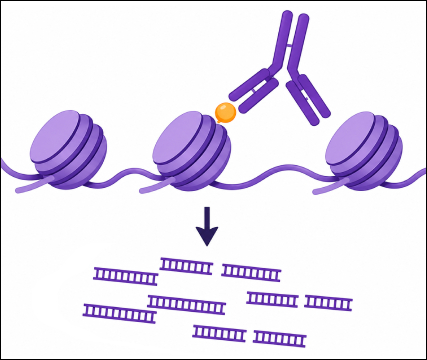
Antibody-based chromatin profiling has become central to studying histone modifications, transcription factors, chromatin regulators, enhancer activity, promoter regulation, and epigenetic state transitions. Yet many failed or difficult experiments begin with a reasonable-looking antibody choice. The antibody may detect the target by western blot. It may stain cells by IF. It may even be described as ChIP-grade. Still, performance can change when the same antibody is used in fixed chromatin, native chromatin, permeabilized nuclei, nuclease-tethered workflows, or library-ready enrichment workflows.
The practical problem is straightforward: antibodies do not bind isolated targets in most chromatin assays. They bind epitopes inside nucleosomes, protein complexes, compacted chromatin, crosslinked material, or permeabilized nuclei. Method context can change epitope exposure, background, enrichment efficiency, peak shape, and downstream interpretation.
This is why target context matters. A strong antibody choice depends on the target class, chromatin state, sample type, expected genomic distribution, readout, and enrichment chemistry. A histone modification antibody, a transcription factor antibody, and an antibody against a chromatin-associated enzyme may each require different validation logic, even when all are used for protein-DNA interaction studies.
For researchers comparing ChIP, CUT&RUN, CUT&Tag, and CUT&LUNCH, the best starting point is not simply asking which method is newest or most sensitive. The more useful question is: which method preserves the target biology while giving the antibody the best chance to bind specifically, enrich cleanly, and generate interpretable data?
Why Antibody Validation Must Be Application Specific
A classic antibody validation problem in epigenomics is that specificity in one assay does not guarantee performance in another. In a large histone antibody assessment, Egelhofer and colleagues evaluated 246 antibodies directed against unmodified histones and 57 histone modifications using western blot, dot blot, and ChIP-chip or ChIP-seq testing. The study emphasized two issues that still affect chromatin profiling today: antibodies can cross-react with non-target modifications, and even apparently specific antibodies can be poor ChIP reagents [1].
ENCODE and modENCODE ChIP-seq guidelines similarly placed antibody validation alongside replication, sequencing depth, data quality assessment, and metadata reporting as key determinants of reliable ChIP-seq data [2]. These guidelines remain relevant because they address a central reality of antibody-based chromatin assays: data quality is shaped by both the reagent and the workflow.
For researchers, this means that "validated" should always be interpreted in context. A western blot validated antibody has evidence for protein recognition under denaturing conditions. An IF validated antibody has evidence for staining in fixed cells. A ChIP validated antibody has evidence for enrichment of chromatin-bound targets. CUT&RUN, CUT&Tag, and CUT&LUNCH add further workflow-specific requirements, including in situ binding and compatibility with cleavage, tethering, or selective recovery.
Start With Target Biology
The first decision is whether the target is a histone modification, transcription factor, polymerase, chromatin remodeler, or cofactor.
Histone modifications are often more tractable because they are abundant, repeated across nucleosomes, and associated with interpretable chromatin states. H3K27ac is commonly used to mark active enhancers and promoters. Creyghton and colleagues showed that H3K27ac distinguishes active enhancers from inactive or poised enhancer elements that contain H3K4me1 alone [3]. H3K27me3, in contrast, is associated with Polycomb-mediated repression and broader repressive chromatin domains.
These marks require different expectations. H3K27ac often produces sharper enrichment at active regulatory regions. H3K27me3 can occupy broader domains, so peak calling, control locus selection, and interpretation should be adjusted accordingly. EpigenTek’s A-4039 supports H3K27me3 profiling in chromatin applications, and A-4708 supports H3K27ac studies where active regulatory chromatin is the target of interest.
Transcription factors are usually more demanding. They may be low abundance, transiently bound, indirectly associated with DNA, or masked by protein partners. A transcription factor antibody must recognize the relevant epitope under assay conditions and generate enough enrichment over background to support locus-specific or genome-wide analysis. For these targets, method selection and control design are as important as antibody choice.
ChIP: Best When Fixation Helps Preserve the Interaction
Chromatin immunoprecipitation remains a flexible approach for studying protein-DNA interactions at selected loci or across the genome. It is especially useful when formaldehyde crosslinking helps preserve weak, indirect, or transient interactions before chromatin shearing and immunoprecipitation.
ChIP favors antibodies that recognize targets in fixed, fragmented chromatin. This is why an antibody that works in western blot or IF may still need ChIP-specific validation. For standard ChIP-qPCR or ChIP-seq, the EpiQuik Chromatin Immunoprecipitation Kit (P-2002) provides a practical ChIP workflow; for lower-abundance targets or limited samples, the ChromaFlash High-Sensitivity ChIP Kit (P-2027) supports higher-sensitivity ChIP analysis.
Practical antibody guidance for ChIP:
- Use ChIP when fixation is important for preserving protein-DNA association.
- Confirm enrichment at a known positive locus and low signal at a negative locus.
- For transcription factors, prioritize antibodies validated in fixed chromatin.
- For histone marks, confirm specificity against related modification states.
CUT&RUN: Antibody Binding in a More Native Context
CUT&RUN was developed to map protein-DNA interactions with antibody-targeted micrococcal nuclease cleavage in situ. Skene and Henikoff described CUT&RUN as a strategy in which antibody-targeted MNase releases specific protein-DNA complexes into the supernatant for paired-end sequencing [4]. This can reduce background and improve resolution compared with conventional ChIP in many contexts.
The antibody challenge is different from ChIP. Instead of binding sheared crosslinked chromatin in solution or on a matrix, the antibody must bind its target in permeabilized cells or nuclei. Epitope accessibility, chromatin compaction, antibody host species, isotype, secondary reagent compatibility, and target abundance can all influence performance.
Histone marks are often more forgiving in CUT&RUN because the target is abundant and repeated. Transcription factors may require more optimization because the target may be scarce or partially inaccessible. A ChIP-grade antibody is usually a useful starting point, but the antibody should still be tested in CUT&RUN with IgG, no-primary controls where appropriate, and positive and negative loci.
CUT&Tag: Antibody-Tethered Tagmentation Adds Another Requirement
CUT&Tag uses antibody-directed tethering of Tn5 transposase to chromatin-bound targets. Kaya-Okur and colleagues described CUT&Tag as an enzyme-tethering strategy for efficient high-resolution sequencing libraries from small samples and single cells [5]. In the CUT&Tag workflow, the antibody binds the chromatin target in situ, and a protein A-Tn5 or related tethered transposase generates sequencing-ready fragments near the antibody-bound site.
This means antibody binding is only one part of performance. The antibody must also support productive tethering. Antibody species, isotype, secondary antibody use, and epitope position can influence the signal. A target with strong ChIP signal may not automatically produce equivalent CUT&Tag signal, especially if the epitope is less accessible in intact nuclei.
Practical antibody guidance for CUT&RUN and CUT&Tag:
- Start with ChIP-validated or chromatin-validated antibodies, then test them in the actual workflow.
- Use IgG and no-primary controls to assess background.
- Expect histone marks and transcription factors to behave differently.
- Avoid assuming that ChIP-seq, CUT&RUN, and CUT&Tag peak profiles are directly interchangeable.
CUT&LUNCH: Selective Recovery Depends on Antibody and Target Context
CUT&LUNCH is designed to profile histone or strong-binding transcription factor DNA complexes directly from cells by combining antibody recognition, targeted cleavage, and selective recovery. Because the workflow depends on antibody binding in permeabilized cells, antibody quality and target context remain central to performance.
For qPCR-based enrichment or downstream library preparation, EpigenTek’s P-2035 provides the CUT&LUNCH assay workflow. For an integrated sequencing workflow, P-2033 combines CUT&LUNCH enrichment with library preparation. In both cases, ChIP-grade antibodies are the preferred starting point, especially for histone marks and strong-binding transcription factors.
Practical antibody guidance for CUT&LUNCH:
- Use P-2035 when enrichment will be assessed by qPCR or used in a separate downstream workflow.
- Use P-2033 when enrichment and NGS library preparation should be integrated.
- Prioritize ChIP-grade antibodies and confirm performance with control loci.
- For transcription factors, focus first on strong-binding targets with clear positive controls.
Match the Antibody to the Expected Signal Pattern
Antibody choice should also reflect the expected genomic pattern. Not all targets create the same data type.
Sharp histone marks, such as H3K4me3 at promoters or H3K27ac at active regulatory elements, usually produce localized enrichment. Broad marks, such as H3K27me3, require different background modeling and peak calling. Transcription factors often generate narrow peaks, but the signal can be highly dependent on binding strength, motif context, cofactor interactions, and cell state.
This matters for control design. For H3K27ac, positive loci should be active promoters or enhancers in the selected sample type. For H3K27me3, positive loci should reflect known repressive domains or Polycomb-regulated regions in that biological system. For transcription factors, controls should be chosen based on prior evidence in the same or closely related cell type, not only general literature.
Product Selector: Antibody and Workflow Fit
| Research need | Product fit | Best target context | Antibody note |
|---|---|---|---|
| Standard ChIP-qPCR or ChIP-seq | EpiQuik Chromatin Immunoprecipitation Kit (P-2002) | Fixed protein-DNA complexes | Use ChIP-grade antibodies for fixed chromatin. |
| Higher-sensitivity ChIP | ChromaFlash High-Sensitivity ChIP Kit (P-2027) | Low-abundance proteins, transcription factors, limited samples | Use ChIP-grade antibodies and strong locus controls. |
| CUT&LUNCH enrichment for qPCR or downstream library prep | EpiNext CUT&LUNCH Assay Kit (P-2035) | Histones and strong-binding transcription factors | Use ChIP-grade antibodies and confirm enrichment before sequencing. |
| Integrated CUT&LUNCH-to-NGS workflow | EpiNext CUT&LUNCH-Seq Kit (P-2033) | Low-input sequencing of histone or strong-binding TF complexes | Use ChIP-grade antibodies with positive and IgG controls. |
| H3K27me3 profiling | Histone H3K27me3 Polyclonal Antibody (A-4039) | Polycomb-associated repression and broad chromatin domains | Fit for H3K27me3 studies where ChIP or ChIP-seq validation is needed. |
| H3K27ac profiling | Histone H3K27ac Polyclonal Antibody (A-4708) | Active enhancers and promoters | Fit for H3K27ac studies of active regulatory chromatin. |
A Practical Decision Framework
Before selecting an antibody for ChIP, CUT&RUN, CUT&Tag, or CUT&LUNCH, ask five questions.
- What is the target class? Histone modifications, transcription factors, polymerases, and chromatin cofactors have different abundance, accessibility, and signal patterns.
- What chromatin state will the antibody encounter? Fixed sheared chromatin, native nuclei, permeabilized cells, and antibody-bound cleavage workflows do not expose epitopes in the same way.
- What readout is needed? ChIP-qPCR, ChIP-seq, CUT&RUN-seq, CUT&Tag-seq, CUT&LUNCH-qPCR, and CUT&LUNCH-Seq have different control and library requirements.
- What signal pattern is expected? Broad marks, narrow marks, punctate transcription factor peaks, and diffuse cofactors require different controls.
- What validation is closest to the planned experiment? A ChIP-seq validated antibody is more informative for genome-wide chromatin profiling than western blot alone, but every new sample type and workflow still deserves controls.
References
- Egelhofer TA, Minoda A, Klugman S, et al. An assessment of histone-modification antibody quality. Nat Struct Mol Biol. 2011;18(1):91-93. doi:10.1038/nsmb.1972. View article
- Landt SG, Marinov GK, Kundaje A, et al. ChIP-seq guidelines and practices of the ENCODE and modENCODE consortia. Genome Res. 2012;22(9):1813-1831. doi:10.1101/gr.136184.111. View article
- Creyghton MP, Cheng AW, Welstead GG, et al. Histone H3K27ac separates active from poised enhancers and predicts developmental state. Proc Natl Acad Sci U S A. 2010;107(50):21931-21936. doi:10.1073/pnas.1016071107. View article
- Skene PJ, Henikoff S. An efficient targeted nuclease strategy for high-resolution mapping of DNA binding sites. Elife. 2017;6:e21856. Published 2017 Jan 16. doi:10.7554/eLife.21856. View article
- Kaya-Okur HS, Wu SJ, Codomo CA, et al. CUT&Tag for efficient epigenomic profiling of small samples and single cells. Nat Commun. 2019;10(1):1930. Published 2019 Apr 29. doi:10.1038/s41467-019-09982-5. View article



