 Our single B-cell derived recombinant rabbit monoclonal antibodies have vastly improved reliability and reproducibility.



 Cart (0)


A DNA extract from an FFPE section or small biopsy can meet a concentration threshold and still produce a weak methylation library. Formalin fixation fragments DNA and introduces chemical damage. Microdissection and small biopsies restrict the number of recoverable molecules. Sodium bisulfite can further degrade the template during conversion. By the time sequencing begins, library complexity may constrain the experiment more than the measured DNA mass.
The study succeeds only if enough independent molecules survive to produce comparable CpG coverage across biological samples. Sequencing more reads cannot restore fragments that disappeared during extraction, conversion, cleanup, or library construction. Limited-sample methylation studies therefore require close control of where molecules are spent and which genomic regions need to remain measurable across the cohort.
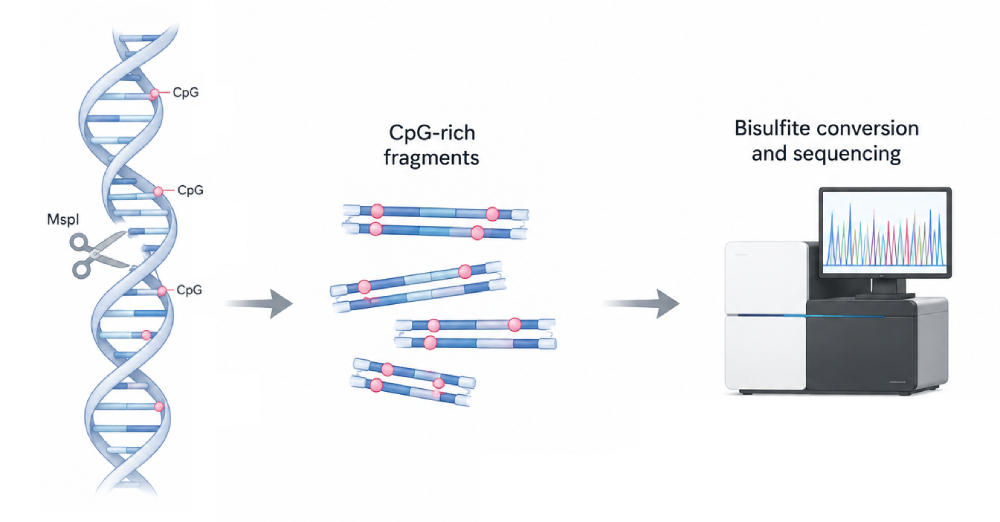
Reduced representation bisulfite sequencing, or RRBS, addresses that problem by restricting sequencing to a CpG-rich fraction of the genome. The method sacrifices comprehensive genomic representation to obtain greater depth at selected methylation-informative regions.
RRBS directs sequencing toward CpG-rich DNA
MspI cleaves CCGG sites without regard to methylation at the CpG. Fragment selection after digestion enriches DNA containing closely spaced CpGs, including many CpG islands and promoter-associated regions. Bisulfite conversion then distinguishes unmethylated cytosines from protected modified cytosines, and sequencing reports methylation at single-base resolution within the represented fragments.
A recent RRBS methods chapter estimates that conventional RRBS measures approximately 5% to 10% of CpG sites in mammalian genomes, with substantial representation of gene promoters and CpG islands. [1] The percentage is deliberately much smaller than the genomic coverage sought with whole-genome bisulfite sequencing, or WGBS.
That restricted representation should be explicit in experimental planning. RRBS samples CpGs across the genome, but it is not comprehensive whole-genome methylome sequencing. WGBS interrogates a much broader genomic space, including CpG-poor intergenic regions and regulatory elements that may fall outside MspI-enriched fragments. A recent WGBS protocol describes sodium bisulfite-associated DNA damage and input-related library loss as continuing technical constraints even in workflows designed to minimize cleanup and PCR duplication. [2]
Promoter-focused studies, CpG-island analyses, and discovery projects centered on recurrent CpG-rich differentially methylated regions can use RRBS coverage efficiently. RRBS can also capture enhancer-associated CpGs, but representation depends on MspI site distribution and fragment selection. Projects centered on distal regulatory regions that are poorly represented by the RRBS fraction, CpG-poor sequence, or comprehensive methylome reconstruction may require broader coverage.
Sources of loss and bias in low-input RRBS
Physical transfers, cleanup and size-selection steps, bisulfite-associated degradation, and inefficient adaptor ligation can reduce the amount or diversity of DNA that reaches the final library. Restriction digestion primarily defines the fragment population, while PCR increases copy number and can introduce duplication or amplification bias when starting diversity is low.
Al Momani and colleagues described an RRBS workflow optimized for 10 to 100 ng of input DNA, including formalin-fixed material. Their protocol replaced gel-based size selection with bead purification and incorporated FFPE-specific handling to support single-base methylation mapping from low-input samples. [3]
Low input increases stochastic sampling. CpG estimates supported by few original fragments are more sensitive to allelic sampling and PCR duplication, even when the amplified library reaches an acceptable concentration.
Biological heterogeneity adds another source of intermediate methylation values. A small tumor biopsy can contain tumor cells, stromal cells, immune cells, vascular cells, and normal tissue. A CpG reported at 50% methylation may reflect a mixture of cell populations, allele-specific methylation, or partial methylation within one population. RRBS measures the molecules present in the library; cell-of-origin interpretation requires appropriate experimental design or computational deconvolution.
FFPE DNA carries damage into the RRBS workflow
Formalin-fixed DNA enters library preparation with a history that fresh genomic DNA does not share. Crosslinking, fragmentation, base damage, fixation conditions, block storage, extraction chemistry, and tissue quality can all affect recoverable DNA. MspI-generated fragments then coexist with DNA ends produced by pre-existing degradation.
Fragment distribution, amplifiability, bisulfite conversion performance, library complexity, and CpG overlap across the cohort are more informative than block age alone.
Zhang and colleagues developed an FFPE-adapted RRBS method and used methylation data from 498 fresh-frozen primary tumors to build classifiers that were subsequently evaluated with 215 metastatic FFPE samples and 68 samples from cancers of unknown primary origin. Their best-performing classifier achieved top-k accuracies ranging from 81% to 93% in the metastatic cohort. [4] The study demonstrates that degraded FFPE DNA can retain reproducible methylation information across large sample sets when library preparation and analysis account for the properties of fixed material.
Retrospective tissue collections remain especially attractive for methylation research because pathology, treatment history, outcome data, or rare disease material may already be linked to archived blocks. Their scientific value depends on consistent recovery of comparable CpGs, not simply on successful library generation from each block.
Workflow design for post-bisulfite RRBS library construction
The EpiNext RRBS Library Fast Kit (P-1069) combines MspI digestion, bisulfite conversion, post-bisulfite library construction, size selection, and amplification for Illumina sequencing. The workflow supports genomic DNA prepared from sample types that include FFPE tissue, biopsy material, microdissected samples, fresh and frozen tissue, and cultured cells.
Adaptor construction occurs after bisulfite conversion in the P-1069 workflow, so completed adaptor-DNA constructs are not exposed to the conversion reaction. This removes bisulfite exposure of pre-ligated constructs from the library workflow.
The workflow remains a reduced-representation method. MspI enrichment determines which genomic fragments are available for sequencing, and sample quality still affects the diversity of fragments recovered. Pilot libraries from representative specimens can reveal whether FFPE damage, extraction quality, or low starting complexity is likely to produce uneven coverage before an entire cohort is processed.
Shared CpG coverage determines whether samples can be compared
RRBS datasets are often summarized with total read count, mapping rate, conversion efficiency, duplication rate, and CpG coverage. Differential methylation analysis depends most directly on the CpGs that remain callable across the samples being compared.
A locus covered deeply in one group but absent from another contributes little to a group comparison. Coverage filters should therefore be applied at the study level rather than by accepting every CpG that passes a threshold in any individual library. Minimum read depth, minimum sample representation, replicate structure, and treatment of missing values should be defined before differential methylation testing.
Conversion efficiency requires separate scrutiny because incomplete conversion creates directional error. An unmethylated cytosine that escapes conversion can be read as methylated. Poor conversion can therefore inflate apparent methylation rather than simply increase random noise.
Duplication should be interpreted alongside read depth because repeated reads do not add independent CpG observations.
Single-ng DNA may require a different reduced-representation chemistry
"Tiny," "low input," and "limited sample" should not be treated as interchangeable categories. Tens of nanograms from an FFPE section present a different library problem from one nanogram of DNA or material approaching single-cell scale.
Liu and colleagues compared conventional RRBS with a reduced-representation enzymatic methylation sequencing method in low-input mouse and human samples. In their experimental comparison, the RRBS protocol did not generate reliable libraries below 2 ng, whereas the enzymatic reduced-representation method generated libraries from 1 to 25 ng. [5] Those data do not establish a universal RRBS cutoff. They show that single-ng material should be evaluated separately from the tens-of-ng samples commonly described as low input.
Very small specimens may justify enzymatic conversion, post-bisulfite whole-genome approaches, single-cell methods, or targeted amplification depending on the biological question. A broader method can be preferable when the study depends on distal regulatory regions that are poorly represented by RRBS or on CpG-poor sequence.
RRBS, global methylation, and separate bisulfite conversion answer different experimental needs
RRBS assigns methylation measurements to individual sequenced CpG positions within its represented genomic fraction. A global methylation assay collapses positional information into a sample-level measurement. The two approaches should not be expected to produce numerically interchangeable readouts.
The MethylFlash Global DNA Methylation (5-mC) ELISA Easy Kit (P-1030) measures global 5-mC abundance without identifying genomic loci. The MethylFlash Global DNA Hydroxymethylation (5-hmC) ELISA Easy Kit (P-1032) provides the corresponding global measurement for 5-hmC. Both can serve as orthogonal assays when total cytosine-modification abundance is part of the study design rather than a substitute for RRBS.
Standard bisulfite sequencing also has a chemical limitation: 5-mC and 5-hmC are both protected from the conventional cytosine-to-uracil conversion and can therefore contribute to the same protected-cytosine signal. Reviews of cytosine-modification methods describe oxidative, enzymatic, affinity-based, and direct sequencing approaches for separating these modifications when 5-hmC requires independent measurement. [6]
The BisulFlash DNA Modification Kit (P-1026) occupies another position in the workflow. It provides bisulfite-converted DNA for downstream methylation analyses, including sequencing and locus-specific methods, without functioning as an integrated RRBS library preparation system.
Matching methylation methods to the research question
| Research objective | EpigenTek product | Experimental role | Main boundary |
|---|---|---|---|
| CpG-rich methylome profiling from FFPE, biopsy, microdissected, or other limited genomic DNA | EpiNext RRBS Library Fast Kit (P-1069) | Integrated RRBS library preparation for Illumina sequencing | Reduced genomic representation; standard bisulfite does not resolve 5-mC from 5-hmC |
| Bisulfite conversion for a separate downstream methylation workflow | BisulFlash DNA Modification Kit (P-1026) | DNA conversion before sequencing, PCR, or other bisulfite-based analysis | Conversion step rather than an integrated RRBS library workflow |
| Sample-level global 5-mC measurement | MethylFlash Global DNA Methylation (5-mC) ELISA Easy Kit (P-1030) | Quantification of global 5-mC | No genomic location information |
| Sample-level global 5-hmC measurement | MethylFlash Global DNA Hydroxymethylation (5-hmC) ELISA Easy Kit (P-1032) | Quantification of global 5-hmC | No genomic location information |
Planning RRBS around the specimen
FFPE sections, biopsies, and microdissected specimens place tighter constraints on assay selection than abundant, high-quality genomic DNA. RRBS is well suited to studies that prioritize CpG-rich methylation measurements and can accept reduced genomic representation.
Sample quality, expected genomic coverage, biological replication, and the need to interrogate poorly represented distal or CpG-poor regions should be defined before library preparation. Those criteria should determine whether RRBS, broader methylome sequencing, or a targeted assay is the appropriate endpoint.
References
- Nakabayashi K, Yamamura M, Haseagawa K, Hata K. Reduced Representation Bisulfite Sequencing (RRBS). Methods Mol Biol. 2023;2577:39-51. doi:10.1007/978-1-0716-2724-2_3. View article
- Vargas-Landin DB, Pfluger J, Nguyen TV, Lister R. Generation of Whole-Genome Bisulfite Sequencing Libraries for Comprehensive DNA Methylome Analysis. Methods Mol Biol. 2024;2842:383-390. doi:10.1007/978-1-0716-4051-7_19. View article
- Al Momani S, Rodger EJ, Stockwell PA, Eccles MR, Chatterjee A. Generating Sequencing-Based DNA Methylation Maps from Low DNA Input Samples. Methods Mol Biol. 2022;2458:3-21. doi:10.1007/978-1-0716-2140-0_1. View article
- Zhang S, He S, Zhu X, et al. DNA methylation profiling to determine the primary sites of metastatic cancers using formalin-fixed paraffin-embedded tissues. Nat Commun. 2023;14(1):5686. Published 2023 Sep 14. doi:10.1038/s41467-023-41015-0. View article
- Liu Q, Helmin KA, Dortzbach ZD, et al. Novel enzyme-based reduced representation method for DNA methylation profiling with low inputs. Nucleic Acids Res. 2025;53(12):gkaf558. doi:10.1093/nar/gkaf558. View article
- Kisil O, Sergeev A, Bacheva A, Zvereva M. Methods for Detection and Mapping of Methylated and Hydroxymethylated Cytosine in DNA. Biomolecules. 2024;14(11):1346. Published 2024 Oct 23. doi:10.3390/biom14111346. View article



