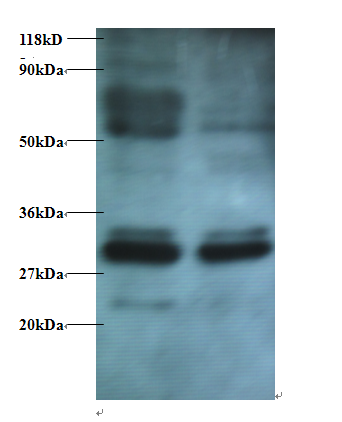
Background
Proper protein folding and post-translational modifications are essential for secretory protein export out of the endoplasmic reticulum. This task is accomplished by chaperone proteins such as protein disulfide isomerase (PDI), GRP94, and BiP. A recently characterized protein, designated ERp29, is closely related to these chaperone proteins and appears to be upregulated during ER stress conditions. ERp29 is a soluble 259-residue protein that is localized to the lumen of the endoplasmic reticulum in all mammalian cells. Research has shown that there are two primary domains within ERp29. The first is the C-terminal region that is a novel, all helical, fold that is most likely involved with ERp29 retention to the ER. The second is the N-terminal region that resembles that of PDIs thioredoxin module. The protein shows sequence similarity to the protein disulfide isomerase family. However, it lacks the thioredoxin motif characteristic of this family, suggesting that this protein does not function as a disulfide isomerase. The protein dimerizes and is thought to play a role in the processing of secretory proteins within the ER.
Description
ERP29 Polyclonal Antibody, HRP Conjugated. HRP. Raised in: Rabbit.
Formulation
Liquid. 0.03% Proclin 300, 50% Glycerol, 0.01M PBS, PH 7.4.
Specificity
Human
Isotype
IgG
Uniprot ID
P30040
Purification
>95%, Protein G purified
Immunogen
Recombinant Human Endoplasmic reticulum resident protein 29 protein (40-251AA)
Storage
Shipped at 4°C. Upon delivery aliquot and store at -20°C (short-term) or -80°C (long-term). Avoid repeated freeze.
Application
ELISA; Recommended dilution: ELISA 1:500-1:1000
 Our single B-cell derived recombinant rabbit monoclonal antibodies have vastly improved reliability and reproducibility.
» 20% off with code
Our single B-cell derived recombinant rabbit monoclonal antibodies have vastly improved reliability and reproducibility.
» 20% off with code