Epigentek Home

Product Categories
Related Products

EpiQuik HDAC Activity/Inhibition Assay Kit (Colorimetric)


Base Product #: P-4002              Availability: Usually Ships In 1-2 Days
Share:
Displaying 1 to 2 (of 2 products) Result Pages:  1 
 Catalog No.+   Product Name   Select Qty.   Price 
 P-4002-48  EpiQuik HDAC Activity/Inhibition Assay Kit (Colorimetric) (48 assays)   $174.00 
 P-4002-96  EpiQuik HDAC Activity/Inhibition Assay Kit (Colorimetric) (96 assays)   $299.00 
Product Overview


We recommend using a newer version of this product: Epigenase HDAC Activity/Inhibition Direct Assay Kit (Colorimetric)


The EpiQuik™ HDAC Activity/Inhibition Assay Kit is a ready-to-use set of essential components needed to measure HDAC activity/inhibition safely and quickly. It is suitable for measuring HDAC activity/inhibition from a broad range of species including mammalian cells/tissues, plants, and bacteria.

WHY CHOOSE THE EPIQUIK™ HDAC ACTIVITY/INHIBITION ASSAY KIT (COLORIMETRIC)?

  • Very quick procedure, which can be completed within 3 hours.
  • Innovative colorimetric assay without radioactivity, extraction, and chromatography.
  • Direct measurement of HDAC activity and inhibition without the use of lysyl endopeptidase, thereby avoiding the false inhibitory effect on HDACs.
  • Strip microplate format makes the assay flexible in both manual and high throughput analysis formats.
  • Simple, reliable, and consistent assay conditions.
Product Details

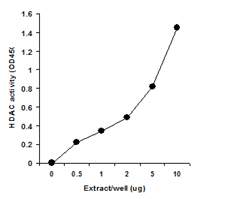
The EpiQuik™ HDAC Activity/Inhibition Assay Kit is designed for measuring total HDAC activity/inhibition. In an assay with this kit, the unique acetylated histone substrate is stably captured on the strip wells. Active HDACs bind to and deacetylate histone substrate. The remaining un-deacetylated substrate can be recognized with a high affinity acetylated histone antibody. The ratio or amount of the un-deacetylated histone, which is inversely proportional to HDAC enzyme activity, can then be colorimetrically quantified through an ELISA-like reaction.

SCHEMATIC PROCEDURE:  


Product Components

H1 (10X Wash Buffer)
H2 (HDAC Assay Buffer)
H3 (Biotinylated HDAC Substrate)*
H4 (HDAC Inhibitor, 0.5 mM)*
H5 (HDAC Standard, 20 µg/ml)*
H6 (Capture Antibody, 100 µg/ml)*
H7 (Detection Antibody, 200 µg/ml)*
H8 (Developing Solution)
H9 (Stop Solution)
8-Well Assay Strip (with Frame)
User Guide

* For maximum recovery of the products, centrifuge the original vial after thawing prior to opening the cap.

Frequently Asked Q's

1. In what kind of medium should the nuclear extract be made?
Any nuclear extraction preparation methods can be used.

2. What classes of HDACs can your HDAC Activity/Inhibition Assay Kit (Cat. No. P-4002) be used for?
At least class 1 and 2 can be assayed with this kit.

3. How many cells should be used per test?
50,000-100,000 cells should be sufficient for each assay point.

4. When doing preparation of the standard curve, "add 50 µl of 1XH1 into the well, followed by adding 1 µl of H5 at a different amount (0.1-10 ng)." It had been mentioned adding 1 µl of H5, what does it mean by different amount (0.1-10 ng)?
Volume is 1 µl. The concentration should be different (several concentration points, ex: 0.1, 0.5, 2, 5, and 10 ng) to generate the dose-response standard curve.

5. In the formula of calculate HDAC activity, does the hour specifically refer to the incubating time 30-60min in step 5?
Yes, the hour here is the incubation time in step 5 (0.5-1 hour).

6. The main HDAC which I am going to detection is HDAC6.The substrate of HDAC6 is tubulin and HSP90. Can I use kit P-4002 to detect this?
Kit P-4002 would be suitable for HDAC6, as the substrate. Included in this kit is universal for class I and II HDACs.

7. In the protocol, the first step is to prepare nuclear extracts. In my experiment, the HDAC which I am going to detect is in the cytoplasm. Can I just use the cytoplasm for detecting HDAC?
You can use the cytoplasm for the HDAC detection, as some of HDACs are in both cytoplasm and nucleus, especially class II.

8. These kits are described as having specificity to a broad range of species. Can you tell me if these antibodies have been validated in any species in particular?
These antibodies have been validated in human, mouse, and rat. These antibodies are also expected to react with a broad range of species due to protein sequence homology.

9. Previously you mentioned that the reaction fluid can be transferred to cuvettes for colorimetric detection. This means that the detected solution is not fixed to the bottom of the plate. But how can you do the repeated wash steps, in this case?
The enzymatically converted product still stick on the strip well and can be repeatedly washed. However, it will generate the colorimetric signal through an ELISA-like reaction at the final step and cause the reaction solution to be colorful.

User Guide & MSDS

[User Guide]*
*Always use the actual User Guide that shipped with your product. Is the above file locked? You can also request user guides by emailing info@epigentek.com along with your contact information and institution name.

[Material Safety Data Sheet]
Product Citations

Trisciuoglio, D. et. al. (January 2012). CPTH6, a Thiazole Derivative, Induces Histone Hypoacetylation and Apoptosis in Human Leukemia Cells. Clin Cancer Res. 18(2):475-486. PubMed Abstract

Shu, L. et. al. (December 2011). Epigenetic CpG demethylation of the promoter and reactivation of the expression of Neurog1 by curcumin in prostate LNCaP cells. AAPS J. 13(4):606-14. PubMed Abstract

Whitworth, KM. et. al. (June 2011). Scriptaid corrects gene expression of a few aberrantly reprogrammed transcripts in nuclear transfer pig blastocyst stage embryos. Cell Reprogram. 13(3) :191-204. PubMed Abstract

Majid, S. et. al. (January 2010). Genistein reverses hypermethylation and induces active histone modifications in tumor suppressor gene B-Cell translocation gene 3 in prostate cancer. Cancer. 116(1): 66-76. PubMed Abstract

Majid, S. et. al. (April 2009). BTG3 tumor suppressor gene promoter demethylation, histone modification and cell cycle arrest by genistein in renal cancer. Carcinogenesis. 30(4):662-670. PubMed Abstract

Majid, S. et. al. (February 2009). BTG3 tumor suppressor gene promoter demethylation, histone modification and cell cycle arrest by genistein in renal cancer. Carcinogenesis Advance Access. 30(4): 662-670. PubMed Abstract

Feedback Form
Epigentek is an epigenetics company that specializes in epigenetic kits, antibodies, reagents, and services for epigenetic research in DNA methylation, histone modification, and chromatin studies.

Copyright © 2012 Epigentek Group Inc. All rights reserved.
Epigentek, the Epigentek logo, and the "Complete Solutions For Epigenetics" slogan are trademarks of Epigentek Group Inc.