IP format Protein immunoprecipitation protocol Use protein IP to enrich a target protein from lysate before Western blot, mass spectrometry, activity testing, or other downstream analysis. The main goal is to pull down the target while minimizing non-specific bead and antibody background. Use this workflow when: Target enrichment before Western blot, confirmation of target pull-down, protein complex cleanup, or low-abundance protein detection. Optimize first: Antibody suitability for IP, bead type, lysis buffer, wash stringency, and elution method. Prepare lysate Lyse cells or tissue under cold, non-denaturing conditions when native antibody recognition is required. Clarify lysate thoroughly before adding antibody or beads. Use fresh protease inhibitors and phosphatase inhibitors when modification state matters.Save an input aliquot before the IP. Pre-clear the sample Incubate lysate with control beads to reduce proteins that bind beads non-specifically. Pre-clearing is especially useful with sticky lysates, tissue extracts, or high-abundance proteins.Keep the pre-cleared lysate as the starting material for the antibody pull-down. Bind antibody and target Incubate lysate with the IP antibody under conditions that preserve the target epitope. Use an antibody validated or suitable for immunoprecipitation when available.Run an IgG control antibody in parallel. Capture with beads and wash Add Protein A, Protein G, or compatible beads, then wash enough to reduce background without losing target. Choose bead type based on antibody species and isotype.Increase wash stringency only after confirming target recovery. Elute and analyze Elute bound protein using a method compatible with the downstream assay. For Western blot, account for antibody heavy chain near 50 kDa and light chain near 25 kDa.Use light-chain-specific, conformation-specific, or directly conjugated detection if antibody chains interfere.
IP format Co-immunoprecipitation protocol Use co-IP to test whether a target protein associates with another protein or protein complex. Compared with standard IP, co-IP requires gentler extraction and washing so interaction partners are retained. Use this workflow when: Protein-protein interaction testing, complex enrichment, tagged bait analysis, and interaction validation. Optimize first: Native antibody binding, gentle lysis, wash stringency, interaction stability, and clean negative controls. Preserve protein complexes Use a gentle, non-denaturing lysis buffer and keep samples cold. Avoid harsh detergents or salt conditions that disrupt the interaction. Use fresh inhibitors and minimize processing time.Save input lysate for comparison with the pull-down. Choose the pull-down target Use an antibody against the bait protein or tag. Confirm that the antibody recognizes the native or minimally denatured protein. Use mock, untransfected, knockout, or IgG controls when possible.Include reciprocal co-IP when interpretation is important. Capture immune complexes Incubate lysate with antibody and beads under gentle mixing conditions. Avoid overmixing or long incubations that increase background.Keep bead volume consistent between test and control IPs. Wash gently Wash under conditions strong enough to remove background but mild enough to preserve the interaction. Increase wash salt or detergent only if background is high.If the partner signal disappears, reduce wash stringency first. Detect bait and partner Elute complexes and analyze by Western blot or another downstream method. Probe for the bait to confirm pull-down efficiency.Probe for the partner to assess interaction enrichment over controls.
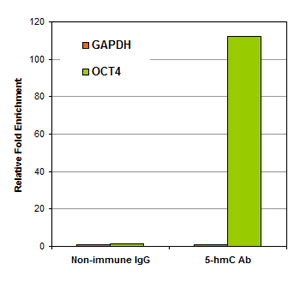
IP format Chromatin immunoprecipitation protocol Use ChIP to enrich DNA fragments associated with a histone modification, transcription factor, chromatin regulator, or DNA-binding protein. ChIP is highly dependent on antibody specificity, chromatin preparation, and shearing quality. Use this workflow when: Histone modifications, transcription factors, chromatin regulators, DNA-binding proteins, and locus-specific enrichment studies. Optimize first: ChIP-suitable antibody selection, chromatin shearing, antibody amount, bead type, wash conditions, and qPCR control loci. Crosslink and prepare chromatin Crosslink cells or tissue when required, quench, lyse, and isolate chromatin under conditions compatible with the target. Use fresh inhibitors and keep samples cold.For histone marks, confirm whether native or crosslinked ChIP is the better fit for the assay design. Shear chromatin Fragment chromatin to the target size range by sonication or enzymatic shearing. Check shearing before IP to avoid poor resolution or inefficient enrichment.Over-shearing can damage epitopes or reduce recovery. Immunoprecipitate chromatin Incubate sheared chromatin with a ChIP-suitable antibody and compatible beads. Include input DNA and IgG control.Use positive and negative genomic loci for qPCR validation when possible. Wash and reverse crosslinks Wash beads to remove non-specific chromatin, then reverse crosslinks if crosslinking was used. Use wash buffers appropriate to the target and antibody strength.Excessively harsh washes can reduce enrichment. Purify and analyze DNA Purify ChIP DNA and analyze by qPCR, sequencing, or another validated readout. Compare enrichment to input and IgG control.Evaluate both positive and negative loci before scaling up.
IP format RNA immunoprecipitation protocol Use RIP to enrich RNA associated with an RNA-binding protein or protein complex. RIP requires strong RNase control, antibody specificity, and careful interpretation with input and IgG controls. Use this workflow when: RNA-binding protein studies, RNA-protein interaction validation, transcript enrichment, and target RNA association testing. Optimize first: RNase control, native antibody recognition, wash stringency, input normalization, and IgG background. Prepare RNase-safe lysate Lyse cells under conditions that preserve RNA-protein interactions while limiting RNA degradation. Use RNase-free reagents, tubes, and tips.Add RNase inhibitors and keep samples cold. Pre-clear and save input Pre-clear lysate with control beads and save an input aliquot for normalization. Input is required to distinguish enrichment from RNA abundance.Include IgG control IP to measure non-specific RNA binding. Capture RNA-protein complexes Incubate lysate with antibody and beads under conditions that preserve the RNA-protein interaction. Use an antibody that recognizes the target protein in native or RIP-compatible conditions.Keep incubation consistent between test and control IPs. Wash without losing RNA Wash beads to remove non-specific material while preserving enriched RNA complexes. Increase stringency carefully if background RNA is high.Excessive washing can reduce true RNA recovery. Purify RNA and analyze Release complexes, purify RNA, and analyze by RT-qPCR, sequencing, or another RNA readout. Include no-RT controls where appropriate.Normalize to input and compare against IgG control.







 Cart (0)


![5-Methylcytosine (5-mC) Monoclonal Antibody [33D3]](images/a1014data1.gif "5-Methylcytosine (5-mC) Monoclonal Antibody [33D3]")