Epigentek Home

Product Categories
Related Products

EpiQuik Tissue Chromatin Immunoprecipitation (ChIP) Kit


Base Product #: P-2003              Availability: Discontinued (see alternative)
Share:
Displaying 1 to 3 (of 3 products) Result Pages:  1 
 Catalog No.+   Product Name   Select Qty.   Price 
 P-2003-1  EpiQuik Tissue Chromatin Immunoprecipitation (ChIP) Kit (24 reactions)   $228.00 
 P-2003-2  EpiQuik Tissue Chromatin Immunoprecipitation (ChIP) Kit (48 reactions)   $369.00 
 P-2003-3  EpiQuik Tissue Chromatin Immunoprecipitation (ChIP) Kit (96 reactions)   $559.00 
Product Overview


We recommend using a newer version of this product: ChromaFlash One-Step ChIP Kit


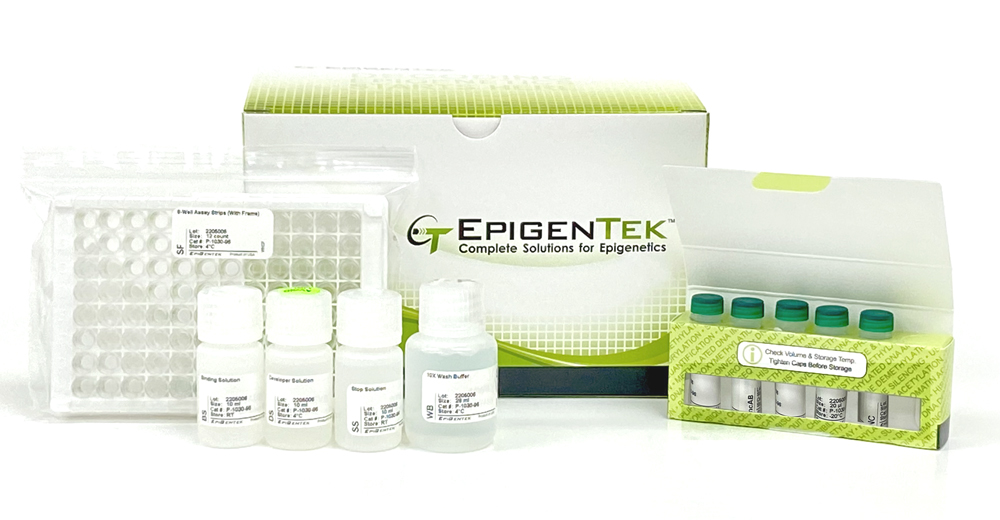
The EpiQuik™ Tissue Chromatin Immunoprecipitation (ChIP) Kit is a convenient package of tools that allows the experimenter to perform chromatin immunoprecipitation (ChIP) from mammalian tissues at extraordinarily rapid speeds and consistency, superior to all other current ChIP methods available. The kit is ready-to-use and provides all the essential components needed to carry out a successful ChIP experiment on tissues. The EpiQuik™ ChIP kits are suitable for combining the specificity of immunoprecipitation with qualitative and quantitative PCR, MS-PCR, DNA sequencing, and southern blot as well as DNA microarray.

WHY CHOOSE THE EPIQUIK™ TISSUE CHROMATIN IMMUNOPRECIPITATION CHIP KIT?


  • The number one fastest procedure available. The entire procedure can be completed within an amazingly short 5 hour period with superb results.
  • The ChIP procedure has been drastically simplified -- extremely short and easy to follow.
  • Strip microplate format makes the assay flexible: manual or high throughput.
  • Columns for DNA purification are included: save tremendous amounts of time and reduce unnecessary physical labor.
  • Compatible with all DNA amplification-based approaches.
  • Achieves very reliable and consistent assay conditions.
Product Details

The EpiQuik™ Tissue Chromatin Immunoprecipitation kit contains all reagents required for carrying out a successful chromatin immunoprecipitation from mammalian tissues. Particularly, this kit includes a positive control antibody (RNA polymerase II), a negative control normal mouse IgG, and GAPDH primers that can be used as a positive control to demonstrate the efficacy of the kit reagents and protocol. RNA polymerase II is considered to be enriched in the GAPDH gene promoter that is expected to be undergoing transcription in most growing mammalian cells and can be immunoprecipitated by RNA polymerase II but not by normal mouse IgG.

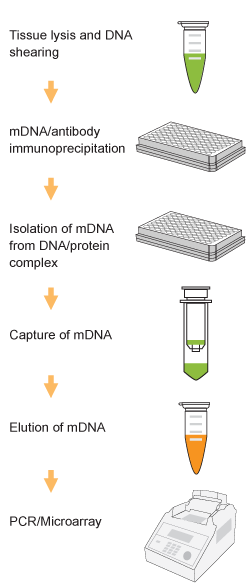
In this ChIP, cells are cross-linked with formaldehyde and chromatin is extracted. The chromatin is then sheared and added into the microwell immobilized with affinity antibodies. Cross-linked DNA is released from antibody-captured protein-DNA complex, reversed and purified through the specifically designed Fast-Spin Column. Eluted DNA can be used for various down-stream applications.

SCHEMATIC PROCEDURE: COMPARATIVE OVERVIEW:
Product Components

CP1 (Wash Buffer)
CP2 (Antibody Buffer)
CP3 (Lysis Buffer)
CP4 (ChIP Dilution Buffer)
CP5 (DNA Release Buffer)
CP6 (Reverse Buffer)
CP7 (Binding Buffer)
CP8 (Elution Buffer)
Homogenizing Buffer
Protease Inhibitor Cocktail (100X)*
Normal Mouse IgG (1 mg/ml)*
Anti-RNA Polymerase II (1 mg/ml)*
Proteinase K (10 mg/ml)*
Control Primer (GAPDH)
Forward (20 µM)*
Reverse (20 µM)*
8-Well Assay Strips (with Frame)
8-Well Strip Caps
F-Spin Column
F-Collection Tube
User Guide

* For maximum recovery of the products, centrifuge the original vial after thawing prior to opening the cap.

Frequently Asked Q's

1. Can IP be overnight?
Yes.

2. Is there any background DNA by mouse IgG IP?
Yes, a little < 2 ng.

3. Can any species Ab be used for the IP?
Yes, if it is an IgG antibody.

4. Can kit P-2003 be used for frozen tissues?
Yes, but it is not as good as fresh samples.

5. How much volume of elution should be added into PCR reaction?
2 µl.

6. Are cell extracts containing 1%SDS compatible with CP4?
No, the SDS concentration in IP solution should be less than 0.1%.

User Guide & MSDS

[User Guide]*
*Always use the actual User Guide that shipped with your product. Is the above file locked? You can also request user guides by emailing info@epigentek.com along with your contact information and institution name.

[Material Safety Data Sheet]
Product Citations

Das, B. et. al. (April 2013). The sld Genetic Defect: Two Intronic CA-Repeats Promote Insertion of the Subsequent Intron and mRNA Decay. J Biol Chem. PubMed Abstract

Fan-xin, M. et. al. (May 2012). Heat shock factor 1 regulates the expression of the TRPV1 gene in the rat preoptic- anterior hypothalamus area during lipopolysaccharide-induced fever. Exp Physiol. 97(6):730-40. PubMed Abstract

John, A. et. al. (May 2012). Bcl11a is required for neuronal morphogenesis and sensory circuit formation in dorsal spinal cord development. Development. 139(10):1831-41. PubMed Abstract

Sui, H. et. al. (March 2012). Epigenetic regulation of reelin and brain- derived neurotrophic factor genes in long-term potentiation in rat medial prefrontal cortex. Neurobiol Learn Mem. Epub ahead of print. PubMed Abstract

Meng, F. et. al. (March 2012). HSF1 regulates the expression of the TRPV1 gene in the PO/AH region of rat hypothalamus during LPS-induced fever. Exp Physiol. Epub ahead of print. PubMed Abstract

Wu, CH. et. al. (November 2011). A double-edged sword role for ubiquitin-proteasome system in brain stem cardiovascular regulation during experimental brain death. PLoS One. Epub. PubMed Abstract

Heinig, M. et. al. (September 2010). A trans-acting locus regulates an anti-viral expression network and type 1 diabetes risk. Nature. 467(7314):460-4. PubMed Abstract

Aoyama, T. et. al. (September 2010). Histone modifiers, YY1 and p300, regulate the expression of cartilage-specific gene, chondromodulin-I, in mesenchymal stem cells. J Biol Chem. 285(39): 29842-50. Full PDF Article

Sui, L. et. al. (June 2010). Effects of perinatal hypothyroidism on regulation of reelin and brain-derived neurotrophic factor gene expression in rat hippocampus: Role of DNA methylation and histone acetylation. Steroids. 75(12): 988-97. PubMed Abstract

Yamaguchi, T. et. al. (June 2010). Cortisol Is Involved in Temperature-Dependent Sex Determination in the Japanese Flounder. Endocrinology. 151(8): 3900-8. PubMed Abstract

Chung, S. et. al. (May 2010). Glutaredoxin1 regulates cigarette smoke-mediated lung inflammation through differential modulation of I{kappa}B kinases in mice: impact on histone acetylation. Am J Physiol Lung Cell Mol Physiol. 299(2): L192-203. PubMed Abstract

Kanfi, Y. et. al. (April 2010). SIRT6 protects against pathological damage caused by diet-induced obesity. Aging Cell. 9(2):162 -73 PubMed Abstract

Aoki, T. et. al. (April 2010). Ets-1 promotes the progression of cerebral aneurysm by inducing the expression of MCP-1 in vascular smooth muscle cells. Gene Therapy. 17(9): 1117-23. PubMed Abstract

Endo, T. et. al. (April 2010). Runx2 Deficiency in Mice Causes Decreased Thyroglobulin Expression and Hypothyroidism. Molecular Endocrinology. 24(6): 1267-73. PubMed Abstract

Molteni, R. et. al. (March 2010). Reduced function of the serotonin transporter is associated with decreased expression of BDNF in rodents as well as in humans. Neurobiol Dis. 37(3): 747-755. PubMed Abstract

Herpin, A. et. al. (February 2010). Transcriptional rewiring of the sex determining dmrt1 gene duplicate by transposable elements. PLoS Genet. 6(2): e1000844. PubMed Abstract 

Joh, K. et. al. (December 2009). Antisense transcription occurs at the promoter of a mouse imprinted gene, Commd1, on the repressed paternal allele. Journal of Biochemistry Advance Access. 146(6): 771-4. PubMed Abstract

Doonan, F. et. al. (April 2009). Rosiglitazone acts as a neuroprotectant in retinal cells via up-regulation of sestrin-1 and SOD-2. J Neurochem. 109(2): 631-43. PubMed Abstract

Yue, L. et. al. (April 2009). Peroxisome proliferator-activated receptor {gamma} stimulation of adipocyte ApoE gene transcription mediated by the liver receptor X pathway. Journal of Biological Chemistry. 284(16): 10453-61. PubMed Abstract

Fuchikami, M. E. et. al. (February 2009). Single immobilization stress differentially alters the expression profile of transcripts of the brain-derived neurotrophic factor (BDNF) gene and histone acetylation at its promoters in the rat hippocampus. Int J Neuropsychopharmacol. 12(1): 73-82. PubMed Abstract

O'Connor J. C. et. al. (October 2008). A novel antioxidant function for the tumour suppressor gene p53 in the retinal ganglion cell. Invest Ophthalmol Vis Sci. 49(10): 4237-44. PubMed Abstract

Aoyama, T. et. al. (January 2008). Cell-specific epigenetic regulation of ChM-I gene expression: Crosstalk between DNA methylation and histone acetylation. Biochem Biophys Res Commun. 365(1): 124-30. PubMed Abstract

Johnson, C. E. et. al. (December 2007). Differential Apaf-1 levels allow cytochrome c to induce apoptosis in brain tumors but not in normal neural tissues. Proceedings of the National Academy of Sciences of the USA. 104(52): 20820-5. PubMed Abstract

Epigentek is an epigenetics company that specializes in epigenetic kits, antibodies, reagents, and services for epigenetic research in DNA methylation, histone modification, and chromatin studies.

Copyright © 2013 Epigentek Group Inc. All rights reserved.
Epigentek, the Epigentek logo, and the "Complete Solutions For Epigenetics" slogan are trademarks of Epigentek Group Inc.