Epigentek Home

Product Categories
Related Products

EpiQuik Total Histone Extraction Kit


Base Product #: OP-0006              Availability: Usually Ships In 1-2 Days
Share:
Displaying 1 to 1 (of 1 products) Result Pages:  1 
 Catalog No.+   Product Name   Select Qty.   Price 
 OP-0006-100  EpiQuik Total Histone Extraction Kit (100 extractions)   $107.00 
Product Overview

The EpiQuik™ Total Histone Extraction Kit is a complete set of optimized buffers and reagents for extracting total core histone proteins (H2A, H2B, H3, and H4) from mammalian cells or tissues in a simple 60 minute procedure. The post-translational modifications in the histone extracts are kept intact and thus can be used with Epigentek's histone modification assay kits  or in a variety of downstream applications for histone methylation, acetylation, phosphorylation, sumoylation, ubiquitination, citrullination, and ADP-ribosylation  studies.

  • Pre-optimized and simple 1 hour protocol.
  • Conveniently includes all essential reagents to carry out a histone extraction.
  • Standardized procedure for reproducible results.
  • Extracts a high yield of total core histones from as little as 1 mg of tissues.
  • Post-translational modifications are kept intact.
  • Does not affect histone modification status or levels.

Background Information
Histones are the chief protein components of chromatin in biology. They act as spools around which DNA winds, and also play a role in gene regulation. The core histones include H2A, H2B, H3, and H4. Histones undergo post-translational modifications, which alter their interaction with DNA and nuclear proteins. The H3 and H4 histones have long tails protruding from the nucleosome, which can be covalently modified at several places (i.e., methylation, acetylation, phosphorylation, etc.). Histone modifications act in diverse biological processes such as gene regulation, DNA repair and chromosome condensation (mitosis). Combinations of modifications are thought to constitute a "histone code" and an understanding of this code may help to answer questions about human development and disease.

Principle & Procedure
The EpiQuik™ Total Histone Extraction Kit simply applies our proprietary histone isolation buffers to cell or tissue samples. After treatment with pre-lysis, lysis, and balance buffers, the total core histones are easily extracted for immediate use or storage under proper conditions.

Starting Materials
The minimal amount of starting materials can be as low as 105 cells or 1 mg tissue. For the best results, the cell number should be greater than 106 cells or the tissue amount should be greater than 10 mg. A total of 100 standard extractions (using 107 cells or 100 mg tissues per extraction) can be performed with this kit. Yield of the total histone proteins is approximately 0.4 mg per 107 cells or 100 mg of tissue. The yield may vary depending on cell or tissue type.


Fig. 1. Schematic procedure of chromation isolation with the EpiQuik™ Total Histone Extraction Kit.

 
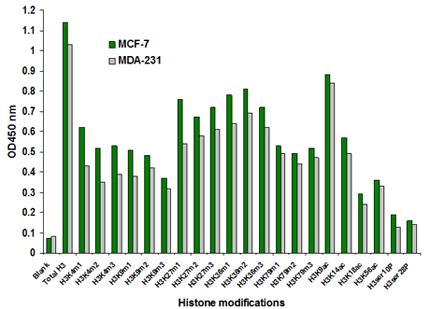
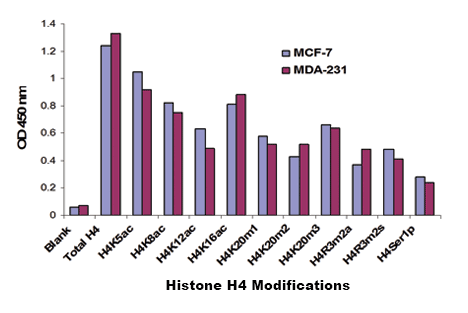
Fig. 2. Histone extracts were prepared from MCF-7 cells using the EpiQuik Total Histone Extraction Kit and acetyl histone H3-K9 was quantified using the EpiQuik Global Acetylated Histone H3-K9 Quantification Kit (Fluorometric) (Cat. No. P-4011).

Product Components

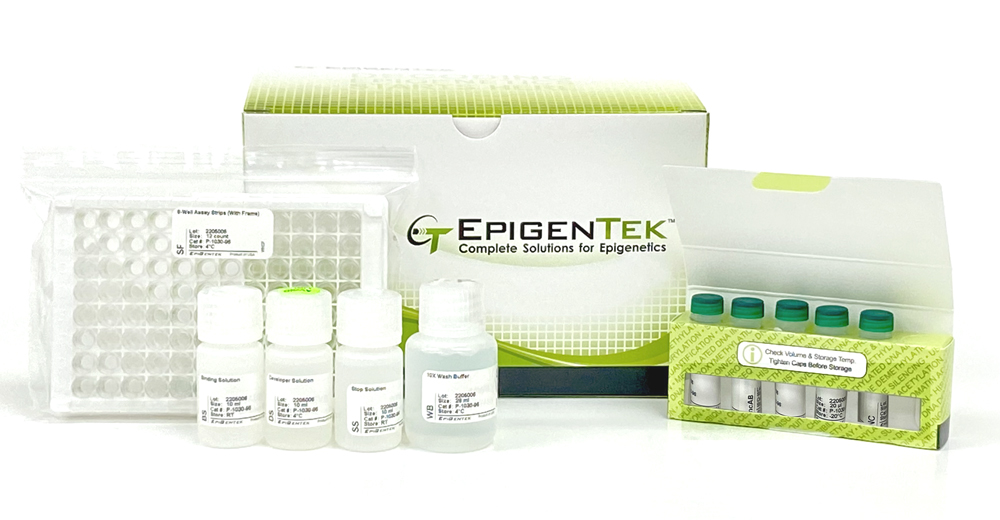
10X Pre-Lysis Buffer
Lysis Buffer
Balance Buffer
DTT Solution
User Guide

User Guide & MSDS

[User Guide]*
*Always use the actual User Guide that shipped with your product. Is the above file locked? You can also request user guides by emailing info@epigentek.com along with your contact information and institution name.

Product Citations

Itzhak, Y. et. al. (May 2013). Sodium butyrate-induced histone acetylation strengthens the expression of cocaine- associated contextual memory. Neurobiol Learn Mem. 102:34-42. PubMed Abstract

Rossi, D. et. al. (February 2013). Croton lechleri Müll. Arg. (Euphorbiaceae) stem bark essential oil as possible mutagen-protective food ingredient against heterocyclic amines from cooked food. Food Chemistry. Epub ahead of print. Abstract

Meng, F. et. al. (February 2013). Anticancer efficacy of cisplatin and trichostatin A or 5-aza-2'- deoxycytidine on ovarian cancer. Br J Cancer. 108(3):579-86. PubMed Abstract

Shuangyan, Luo. et. al. (January 2013). Aberrant histone modifications in peripheral blood mononuclear cells from patients with Henoch-Schönlein purpura. Clinical Immunology. Abstract

McCabe, MT. et. al. (December 2012). EZH2 inhibition as a therapeutic strategy for lymphoma with EZH2-activating mutations. Nature. 492(7427) :108-12. PubMed Abstract

Timofeeva, OA. et. al. (October 2012). STAT3 suppresses transcription of proapoptotic genes in cancer cells with the involvement of its N-terminal domain. Proc Natl Acad Sci U S A. Epub ahead of print. PubMed Abstract

Rehan, VK. et. al. (October 2012). Perinatal nicotine exposure induces asthma in second generation offspring. BMC Med. Epub ahead of print. PubMed Abstract

Fan, H. et. al. (October 2012). Sulforaphane causes a major epigenetic repression of myostatin in porcine satellite cells. Epigenetics. Epub ahead of print. PubMed Abstract

Kao, GS. et. al. (October 2012). Neonatal isolation decreases cued fear conditioning and frontal cortical histone 3 lysine 9 methylation in adult female rats. Eur J Pharmacol. PubMed Abstract

Itzhak, Y. et. al. (March 2012). Histone acetylation rescues contextual fear conditioning in nNOS KO mice and accelerates extinction of cued fear conditioning in wild type mice. Neurobiol Learn Mem. Epub ahead of print. PubMed Abstract

Wurm, T. et. al. (March 2012). The HTLV-1-encoded protein HBZ directly inhibits the acetyl transferase activity of p300/CBP. Nucleic Acids Res. Epub ahead of print. PubMed Abstract

Zhao, M. et. al. (February 2012). Abnormal epigenetic modifications in peripheral blood mononuclear cells from patients with alopecia areata. Br J Dermatol. 166(2):226-73. PubMed Abstract

Neri, F. et. al. (February 2012). Myc regulates the transcription of the PRC2 gene to control the expression of developmental genes in embryonic stem cells. Mol Cell Biol. 32(4):840-51. PubMed Abstract

Ponomarev, I. et. al. (February 2012). Gene Coexpression Networks in Human Brain Identify Epigenetic Modifications in Alcohol Dependence. J. Neurosci. 32(5):1884-97. PubMed Abstract

Qu, F. et. al. (February 2012). A molecular mechanism underlying ovarian dysfunction of polycystic ovary syndrome: hyperandrogenism induces epigenetic alterations in the granulosa cells. J Mol Med (Berl). Epub ahead of print. PubMed Abstract

Zhao, M. et. al. (February 2012). Abnormal epigenetic modifications in peripheral blood mononuclear cells from patients with alopecia areata. Br J Dermatol. 166(2):226-73. PubMed Abstract

Yamamura, Y. et. al. (October 2011). TNF-a inhibits aquaporin 5 expression in human salivary gland acinar cells via suppression of histone H4 acetylation. J Cell Mol Med. 141(8):1464-8. PubMed Abstract

Jing, L. et. al. (April 2011). Effect of the histone deacetylase inhibitors on behavioural sensitization to a single morphine exposure in mice. Neurosci Lett. 494(2): 169-73. PubMed Abstract 

Kawakami, K. et. al. (January 2011). Long interspersed nuclear element-1 hypomethylation is a potential biomarker for the prediction of response to oral fluoropyrimidines in microsatellite stable and CpG island methylator phenotype-negative colorectal cancer. Cancer Sci. 102(1): 166-74. PubMed Abstract

Hansen, A. et. al. (July 2010). Development of a drug screening platform based on engineered heart tissue. Circulation Research. 107(1): 35-44. PubMed Abstract

Diehl, F. et. al. (March 2010). Cardiac deletion of smyd2 is dispensable for mouse heart development. PLoS One. 5(3): e9748. PubMed Abstract

Epigentek is an epigenetics company that specializes in epigenetic kits, antibodies, reagents, and services for epigenetic research in DNA methylation, histone modification, and chromatin studies.

Copyright © 2013 Epigentek Group Inc. All rights reserved.
Epigentek, the Epigentek logo, and the "Complete Solutions For Epigenetics" slogan are trademarks of Epigentek Group Inc.